
Automation Didn’t Fix Paid Ads — It Made Outsourcing PPC Essential for Agencies
- December 31, 2025
- AI, Outsourcing, PPC
Between Google's introduction of Smart Bidding and Meta's introduction of automated placements, there was a time when agencies truly thought, "This is it." Finally, automation will simplify paid advertisements.
Self-optimization would occur in campaigns.
Budgets would find conversions magically.
While teams concentrated on strategy and expansion, AI would silently operate in the background.
However, that isn't the case.
The majority of agencies aren't drinking coffee and watching dashboards get better these days.
They frequently engage in activities more akin to fighting fires daily.
Budgets increase.
Leads pour in, but half of them are garbage.
Credit from branded campaigns is stolen by Performance Max.
Customers send screenshots of the "recommendations" that Google sent them via email.
When Google introduced Smart Bidding and Meta introduced automated placements, agencies genuinely thought, "This is it." Lastly, automation will make paid ads easier.
In campaigns, self-optimization would take place.
Budgets would magically find conversions.
AI would work quietly in the background while teams focused on strategy and growth.
That isn't the case, though.
Nowadays, most agencies aren't sipping coffee and watching dashboards improve.
They often participate in daily activities that are more akin to fighting fires.
Budgets grow.
Half of the leads that come in are trash.
Performance Max steals credit from branded campaigns.
Clients email screenshots of the "recommendations" that Google sent them.
Automation Promised Efficiency. It Delivered Complexity.

On paper, automation sounds lovely.
Learn-based bid strategies.
Audience targeting that is flexible.
Algorithms that test more quickly than people could.
However, algorithms are unable to comprehend context.
Additionally, sponsored advertisements are contextual.
An industry where margins are already extremely thin, a sales team is complaining about
- Low-quality leads,
- Seasonal fluctuations that don't appear in "last-30-day data,"
- A founder who can't afford another poor quarter is aware of all the things that automation misses, especially when PPC budget allocation decisions are being made blindly by systems trained to spend, not protect margins.
Automation adjusts to the signal it has been trained on.
Let's face it, platforms are designed to increase spending, volume, and attributed conversions.
"Healthy profit for your client" is not what I mean.
Because of this, agencies continue to observe things such as:
- Increased impressions but decreased intent
- Rising CPA on "automated" campaigns.
- Expansion of keywords into unrelated areas
- Automated suggestions are driving up spending
There is no problem with the algorithm.
It is performing precisely what it was designed to do.
However, agencies are left to tell clients, "Yes, technically conversions increased.
No, those aren't the appropriate conversions.
Yes, this was done by automation.
It's misaligned, but it's not broken.
And that talk quickly becomes boring.
Agencies Aren’t Bad at PPC. They’re Drowning in It.
The majority of agencies do not have difficulties due to a lack of expertise.
Their world changed more quickly than their team structure, which is why they struggle.
PPC appeared doable three years ago:
- Create campaigns
- Optimize keywords and bids.
- Report on ROAS and leads.
These days, a single account could need:
- PPC Audits of automation
- Creative testing loops for cross-channel attribution logic
- Curation of search terms for privacy compliance
- Alignment of GA4
- CRM integration,
- Audience layering,
- Human-language performance explanation
Multiply that by 15 to 30 customers.
And it is no longer "PPC management."
Cognitive overload is the cause.
Furthermore, automation increased oversight rather than eliminating work.
Even excellent internal PPC managers are overworked, serving as a combination of strategist, analyst, therapist, and firefighter.
In the meantime,
- Expectations surged,
- Hiring slowed,
- Senior PPC salaries increased.
At some point, agency owners began to inquire, "Is our PPC service truly scalable? Or do we jointly duct-tape it each month?
That’s usually the moment they realize they don’t need more tools—they need an outsourced PPC company that can absorb execution without sacrificing strategic control.
At that point, outsourcing began to sound like relief rather than weakness.
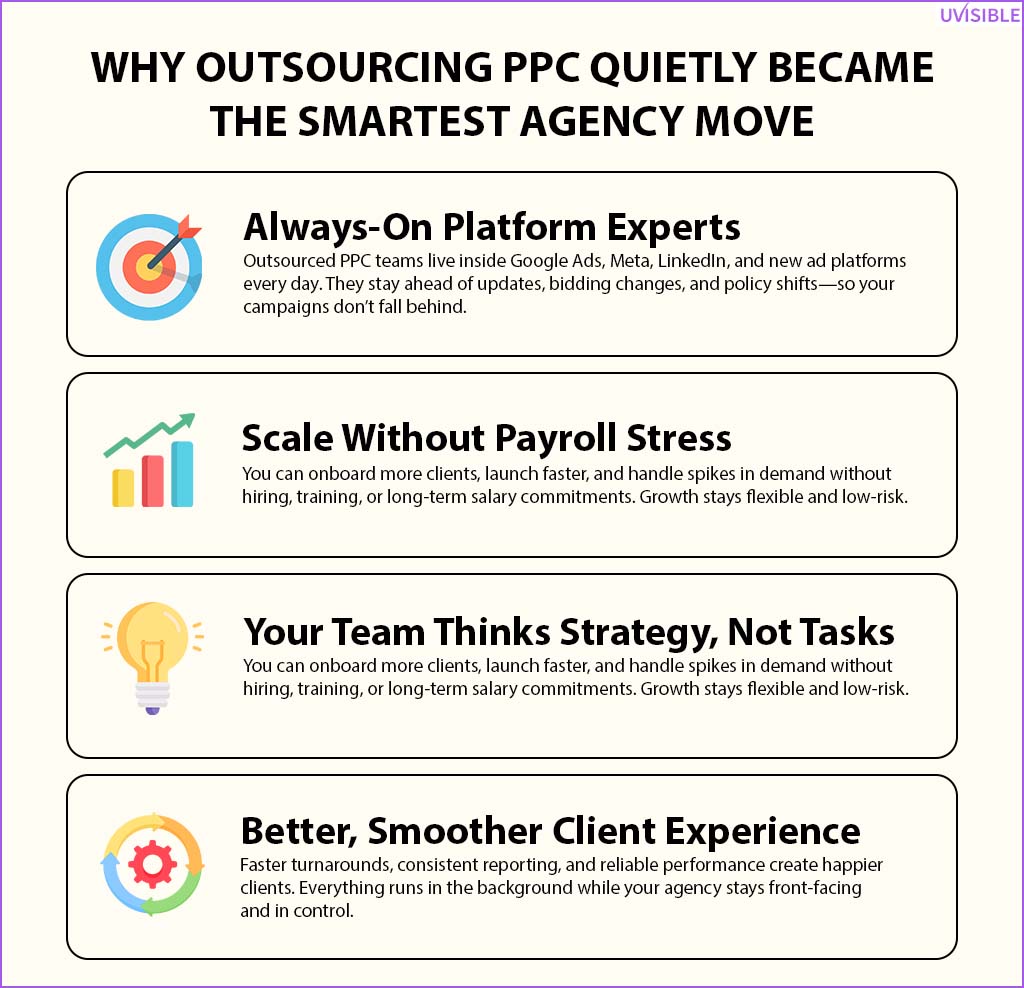
Why Outsourcing PPC Quietly Became the Smartest Agency Move
To be clear, outsourcing PPC does not entail shirking accountability.
It's about shifting who manages the complexity while maintaining control over relationships.
When PPC is outsourced properly, agencies don't feel smaller.
They have a lighter feel.
This is the reason it works.
- Experts are always present on the platforms.
A competent white-label PPC company manages dozens, sometimes hundreds, of accounts in various industries.
They identify trends more quickly than any internal manager could, including which bid strategies are subtly failing, which automation behaviors appear promising, which industries require manual overrides, and which metrics genuinely forecast successful campaigns.
Because they encounter platform patterns daily under various circumstances, they can recognize them.
And when a new "helpful" automation option is introduced by Google?
Before your client becomes the subject of the experiment, it has already been tested elsewhere.
Just the learning curve is invaluable.
- You scale delivery — without scaling payroll risk
Senior PPC talent hiring is costly and time-consuming.
Recruiting takes two to three months, training takes weeks, and trust takes months to develop.
Even so, a single resignation can destroy your sense of fulfillment.
The equation is altered by outsourcing PPC: work scales instantly, costs remain stable, capacity adapts to pipeline changes, and knowledge doesn't vanish when an employee departs.
Instead of asking themselves, "Can we handle another PPC client?" agencies ask themselves, "Can we close them? Delivery is already taken care of.
Everything is altered by that change in perspective.
- Your internal team finally gets to be strategic again

The majority of agency teams did not register for babysitting dashboards.
Their goals were to:
- Create offers
- Map funnels
- Create messaging that increases conversions, strengthens client relationships, and finds growth prospects.
However, "urgent fixes" take the place of strategy when paid advertisements become overwhelming.
Your team gains time back through outsourcing.
They begin determining direction instead of battling algorithms.
Customers sense it right away:
- Greater clarity,
- Improved communication,
- More capable leadership
And all of a sudden, retention increases without increasing acquisition costs.
- The client experience becomes smoother.
"Are my ads profitably growing the business?" is the only thing that matters to clients.
When outsourcing is done correctly:
PPC Campaigns feel deliberate rather than experimental as reporting becomes more transparent and optimization cycles speed up.
The partner behind the curtain is invisible to them.
They perceive an agency that maintains composure and confidence while delivering consistently.
Building trust is difficult, but losing it is simple.
It is protected by outsourcing.
“But Won’t Clients Think We’re Not Doing the Work?”
This fear is understandable and widespread.
However, outsourcing is not how great agencies replace themselves.
They maintain internal strategy and relationships while outsourcing to improve execution.
Consider sectors other than marketing:
- Lab tests are not processed by doctors.
- Concrete is not poured by architects.
- CEOs don't create the product by hand.
- Collaboration led by experts is maturity, not dishonesty.
"We work with a dedicated PPC team that specializes in performance at scale," is all that is left in the script.
It enables us to provide you with more in-depth knowledge while maintaining our focus on strategy and expansion.
Customers don't object to that.
They honor it.
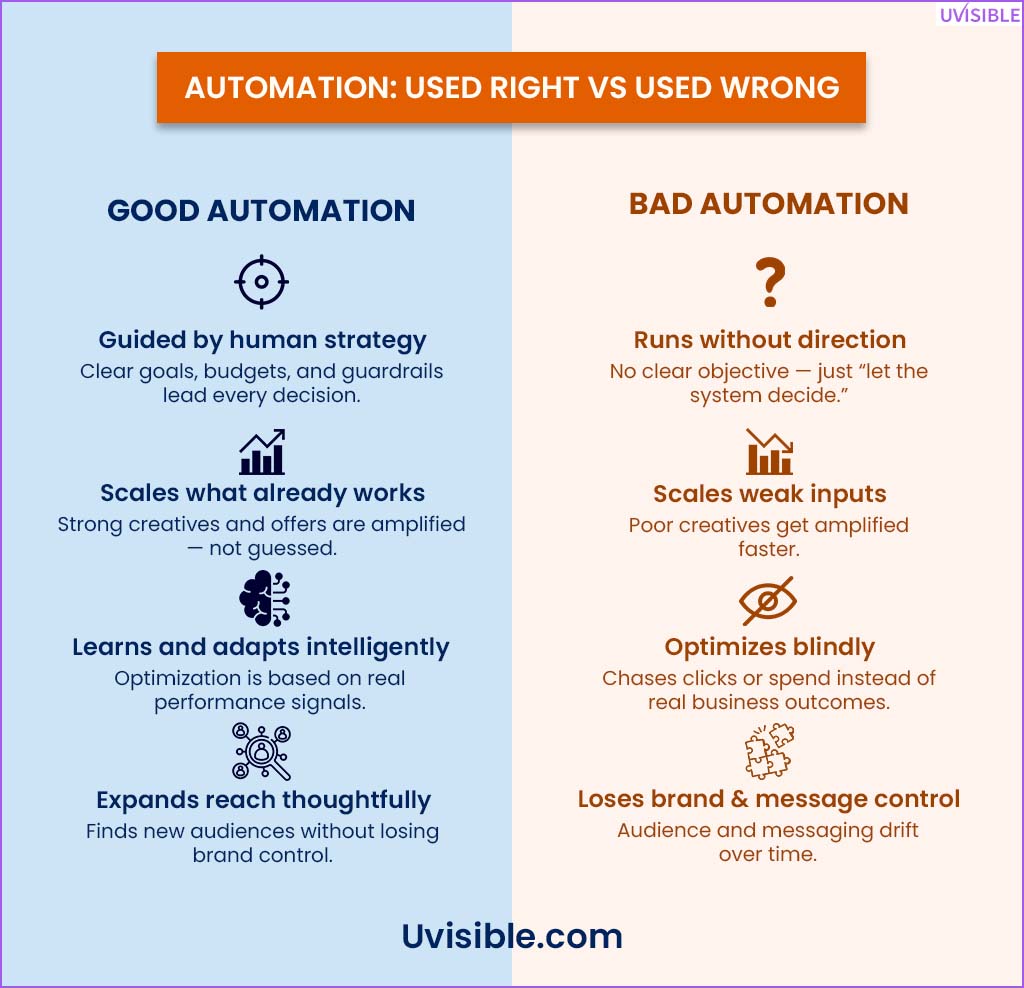
Automation Isn’t the Enemy — Misalignment Is
Let's treat automation fairly.
When properly guided, it accomplishes amazing things:
- Evaluates creatives on a large scale
- Accelerates optimization loops,
- Finds audiences that people wouldn't consider testing,
- Adapts more quickly than manual setups could.
PPC won't be destroyed by automation.
Its purpose is to magnify the person operating it.
However, it veers toward platform goals rather than business goals in the absence of strategic oversight.
Because of this, the current winning model looks like this:
Automation + Human Strategy + Precision Execution Outsourced
automation to increase productivity.
Professionals for guidance.
Scalability through outsourcing.
That is the operational foundation of the fastest-growing agencies, not just theory.
Real Talk: Who Should Seriously Consider Outsourcing PPC?
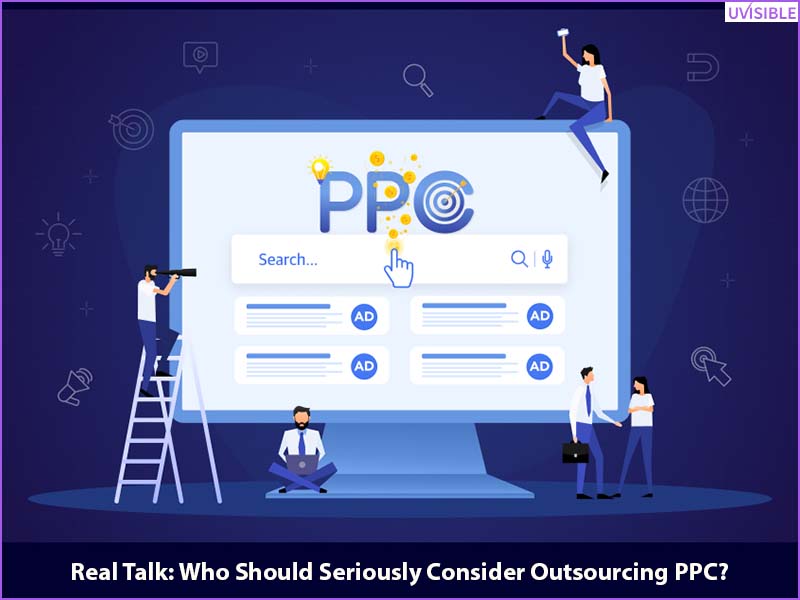
Outsourcing is not necessary for every agency.
However, some signals make the choice clear.
You're probably at the threshold if any of these seem too familiar to you:
- Campaigns are effective. But only when they are touched by one particular team member.
- Because fulfillment seems risky, you are reluctant to pitch PPC because reporting takes longer than optimization.
- Automation continues to perform "mysterious" tasks that are difficult to fully explain, and profitability varies excessively from month to month.
- Rather than focusing on growth planning, your top strategists are deeply involved in Google Ads.
That isn't a failure.
This business model is expanding beyond its existing framework.
Furthermore, hiring more "generalist PPC managers" isn't how most agencies address that.
By re-architecting PPC management services, they resolve the issue.
The New Reality: Automation Didn’t Kill PPC Jobs — It Raised Expectations
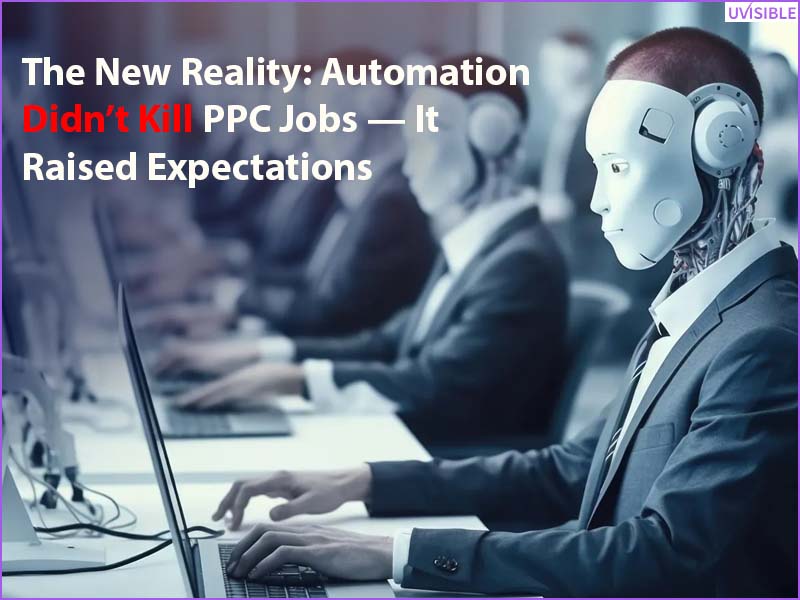
The idea that "AI will replace marketers" is utterly false.
The need for PPC talent was not eliminated by automation.
It revealed the distinction between:
- Button-pushers who relied on campaign micromanagement
- Strategists who are aware of how growth is fueled by paid traffic
Agencies can spend more time where value is created by outsourcing PPC:
Provides a lifetime value strategy, funnel alignment, brand positioning, and customer psychology.
Additionally, it leaves the ongoing manipulation of algorithms to experts designed for that setting.
That isn't outsourced work.
That is the weight of outsourcing.
Final Thought — Agencies That Partner Will Outperform Agencies That Resist
A new era has begun.
Automation operates more quickly than a single PPC manager.
Platforms evolve more quickly than most teams can retrain.
Customers don't want complexity, but they do expect sophistication.
Organizations that adhere to the notion that "we must do everything in-house to prove value" will eventually burn out.
Businesses that declare, "We'll own the strategy — and partner for elite execution," will grow covertly.
PPC was not made simpler by automation.
It made cooperation, specialization, and clarity crucial.
And the organizations that now recognize that?
They won't merely endure this change.
They'll create a fulfillment model that at last seems viable.
If you're interested in learning more about outsourcing PPC without giving up control over your clients, Uvisible can guide you through the process openly and honestly:
- where outsourcing is beneficial
- where it shouldn't be used, what the actual outcomes are, and how to incorporate it into your existing process
- There's no pressure. Avoid making a loud pitch.
- Just clarity between agencies.
Because, according to Uvisible, automation isn't the quick fix that everyone anticipated.
It's a partnership.
About us and this blog
We are a digital marketing company with a focus on helping our customers achieve great results across several key areas.
Request a free quote
We offer professional SEO services that help websites increase their organic search score drastically in order to compete for the highest rankings even when it comes to highly competitive keywords.
Subscribe to our newsletter!
More from our blog
See all posts



Recent Posts
- How SEO Works in Bing (And Why Ignoring It Might Be Costing You More Than You Think) February 27, 2026
- Things Every Website Should Have: The Complete SEO Blueprint February 14, 2026
- Digital Marketing Conferences 2026: Top Global Events for Marketing Leaders February 7, 2026
Pingback: Why Startups & SMEs Are Outsourcing Digital Marketing