
White Label SEO vs Hiring an In-House SEO Team: Which Is Better?
- March 27, 2026
- Outsourcing, SEO
Let's be honest for a moment: hiring an internal SEO team is no longer inexpensive.
Building an in-house SEO team—including a skilled manager, content writer, and link-building expert—can cost you anywhere between $30,000 and $75,000 annually. And that's before you even use tools like Surfer SEO, Ahrefs, or SEMrush. When you include management overhead, attrition, and training, SEO starts to feel more like a money pit than a growth engine.
The larger issue is that most agencies still struggle to grow beyond 10–15 clients despite all that investment.
What is actually wrong, then?
Usually, it comes down to three factors:
- Restricted bandwidth
- Slow hiring cycles
- Inconsistent performance
This is where the argument between in-house and white-label SEO begins.
For complete control, should you assemble your own team? Or scale more quickly without the hassles of hiring by outsourcing execution?
This is a business model choice, not just a tactical one. Your margins, rate of growth, and client retention are all directly impacted by the decision you make.
We won't give you general definitions in this guide. To help you determine what actually works for your company, we'll break down actual costs, ROI, scalability, and agency use cases.
What Should You Choose?
Here's the simple answer if you're pressed for time: both in-house and white-label SEO are effective, but they serve quite different purposes.
If growth is your top priority, go with a white-label SEO agency. For agencies looking to grow rapidly without becoming mired in hiring cycles, this model is ideal. Salary, training, and tool subscriptions are not your concerns.
Rather, you have access to a full team of experts who are prepared to work right away, including link builders, technical SEO specialists, and content writers. The outcome? Better margins, quicker delivery, and the capacity to take on more clients without adding to the strain on operations.
However, if control is your primary concern, in-house SEO makes sense. Establishing your own SEO department can be a wise investment if you want closer brand alignment, direct team communication, and long-term internal expertise. However, it is less scalable and more expensive.
The best agencies in 2026 aren't picking one over the other; that is a wise observation most blogs overlook.
Both are being combined.
They outsource execution to reliable partners like Uvisible while keeping strategy and client communications in-house, giving them the best of both worlds: control and scalability.
What is White Label SEO vs In-House SEO?
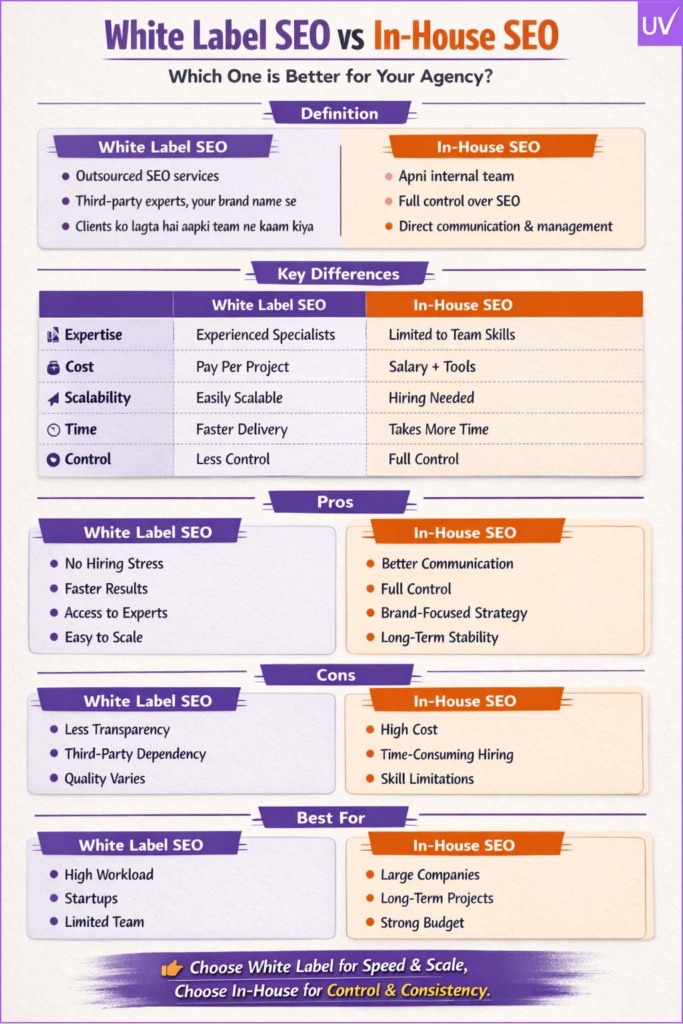
To be honest, most blogs overcomplicate this section, so let's keep it simple before delving deeper.
Outsourcing SEO services to a third party and delivering them under your own brand name is known as white-label SEO. Your client is unaware that another team is involved. Everything is done in the background, including backlink building, content production, and keyword research.
Consider it similar to Zomato's cloud kitchen. Someone else is effectively managing the kitchen in the background, but you own the pricing, the customer relationship, and the brand.
Now contrast that with internal SEO.
Here, you create and oversee your own internal staff, which includes writers, analysts, outreach experts, and SEO managers. Strategy, execution, and communication are all entirely within your power. It sounds fantastic, doesn't it? It is—until you account for continuous operating expenses, training time, and recruiting delays.
Who is doing the labor isn't the only thing that makes a difference.
It concerns:
- Execution speed
- The cost structure
- Potential for scalability
White-label SEO is designed to be adaptable and expandable. Control and consistency are key components of in-house SEO.
Finding one that fits both your present stage and your long-term objectives is crucial.
Real Cost Breakdown
This is when most agencies get their "aha" moment, so let's speak about figures.
It takes more than just pay to assemble an internal SEO staff. The investment is full-stack.
In India, this is a realistic breakdown:
- SEO Manager: ₹8–₹15L annually
- ₹3L–₹6L annually for content writers
- Link Building Expert: ₹4L to ₹8L annually
That's already between ₹15L and ₹30L a year, and we're still being cautious.
Add now:
- ₹2–₹5L annually for SEO tools (Ahrefs, SEMrush, Surfer)
- Onboarding and training
- Costs associated with employee attrition
- Time spent on management
Suddenly, the annual cost of your SEO department can range from ₹25L to ₹60L+.
The problem is that it is difficult to scale. The workload increases with each new client, necessitating additional staff.
Now contrast this with white-label search engine optimization.
Usually, you pay a set monthly fee based on clients or deliverables: no tool subscriptions, no hiring, and no training. In essence, you're turning fixed costs into variable costs, which greatly improves cash flow.
For this reason, many expanding agencies are starting to outsource their SEO services.
Because it is predictable, scalable, and far less stressful and less expensive.
| Cost Component | In-House SEO Team (Annual) | White Label SEO (Monthly/Annual) |
| SEO Manager Salary | ₹8L – ₹15L | Included |
| Content Writer Salary | ₹3L – ₹6L | Included |
| Link Building Specialist | ₹4L – ₹8L | Included |
| SEO Tools (Ahrefs, SEMrush, etc.) | ₹2L – ₹5L | Included |
| Training & Onboarding | ₹1L – ₹3L | Not Required |
| Employee Attrition Cost | High (variable) | None |
| Management Overhead | High (time + cost) | Minimal |
| Scalability Cost | High (hire more people) | Flexible (pay per client) |
| Total Estimated Cost | ₹25L – ₹60L+/year | ₹1L – ₹5L/month (₹12L – ₹60L/year depending on scale) |
ROI Comparison
Cost is one thing, but the true decision is made based on ROI.
Your returns are frequently delayed when using in-house SEO. Hiring and training take up the first two to three months. After that, it will take several more months to harmonize workflows and processes. When your team reaches its peak production, you've already made significant investments that won't pay off right now.
Now, look at the benefits of hiring a white-label SEO services.
You connect to a team that has previously received training. Almost immediately, execution begins. Campaigns launch more quickly. Results appear more quickly. Your client happiness and, more significantly, your retention rates are directly impacted by it.
This is completely different from a business standpoint.
- Faster delivery = happier clients
- Happier clients = longer contracts
- Longer contracts = higher lifetime value
The best part is that your margins also increase.
Because white-label partners reduce overhead and increase efficiency, agencies that use them frequently report 30–50% larger profit margins.
Because of this, the topic of discussion is no longer limited to price.
It concerns:
- How soon can you deliver results?
- How well can revenue be scaled?
Additionally, white-label SEO typically has a distinct advantage in this situation.
| ROI Factor | In-House SEO | White Label SEO |
| Time to Start Execution | 1–3 months (hiring + training) | Immediate (ready team) |
| Time to See Results | Slower (process setup needed) | Faster (proven workflows) |
| Cost per Client | High (fixed salaries regardless of clients) | Lower (pay per client/model) |
| Profit Margins | 15% – 30% (due to overheads) | 30% – 50%+ (lean model) |
| Client Onboarding Speed | Limited by team capacity | Fast & scalable |
| Operational Efficiency | Medium (depends on team skill) | High (specialized experts) |
| Flexibility | Low (fixed team size) | High (scale up/down anytime) |
| Risk Factor | High (attrition, underperformance) | Medium (depends on partner quality) |
| Revenue Scalability | Linear growth | Exponential growth potential |
| Break-even Timeline | Longer (high upfront investment) | Faster (low upfront cost) |
Scalability: The Real Growth Bottleneck
The unsettling reality is that most agencies fail because they are unable to manage expansion rather than a lack of clients.
Scaling an internal model is excruciatingly slow.
Your team is unexpectedly overworked when you acquire a few more clients. What then do you do? You make a hire. However, hiring takes an average of 30 to 60 days. Next are process alignment, onboarding, and training. You've already encountered bottlenecks by the time your new hire reaches maximum productivity.
This leads to an annoying cycle:
Growth → Hiring → Overload → Delay → Repeat
Compare this to white-label SEO now.
This month, you need to onboard five new clients. Done.
Next quarter, do you need to scale to 20 clients? Still feasible.
Because you are utilizing an already-established workforce, you are not constrained by internal bandwidth.
For this reason, many say:
- "The growth of internal SEO is linear." The growth of white-label SEO is exponential.
Additionally, quickness is important in the cutthroat industry of today.
Organizations that grow more quickly:
- Increase your market share
- Produce outcomes more quickly
- Develop closer ties with your clients
Scalability is essential if you want to grow.
Control vs Convenience
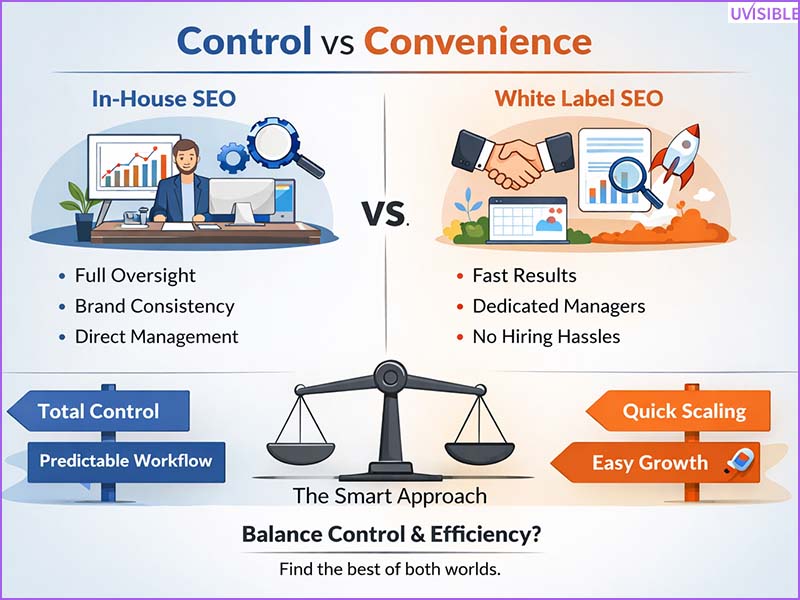
To be honest, most agency owners are hesitant at this point.
You have total control when you use in-house SEO. Your team closely adheres to your brand voice, operates under your direction, and follows your procedures. Feedback is immediate, communication is straightforward, and everything seems... predictable.
That degree of control is reassuring to many businesses.
However, there is a trade-off: flexibility is sacrificed.
Take a look at white label SEO now.
Convenience and speed come at the expense of some degree of control. The team is not directly managed by you. You depend on a partner to produce outcomes. Indeed, misalignment can result from selecting the incorrect partner.
However, the experience is entirely different when you have the right partner.
You receive:
- Dedicated account managers
- Organized white label seo reporting
- Scalable implementation
Without having to deal with employee management, training, or hiring.
The truth is that there isn't a perfect model.
In-house is effective if control is your primary concern.
White label wins if efficiency and growth are more important.
And if you'd like both? Next up is a more intelligent approach.
Hidden Challenges
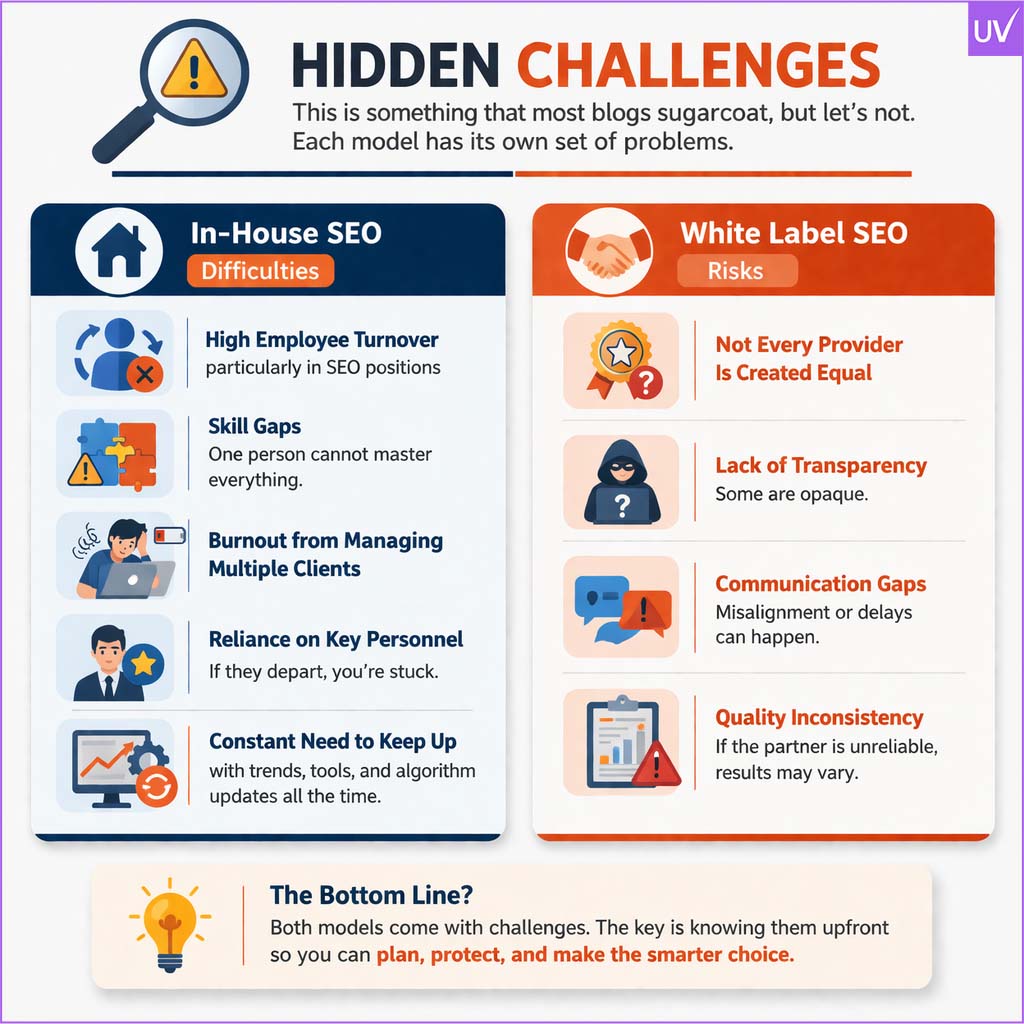
This is something that most blogs sugarcoat, but let's not.
Each model has its own set of problems.
In-house SEO Difficulties:
- High employee turnover, particularly in SEO positions
- One person cannot master everything due to skill gaps.
- Burnout from managing several clients
- Reliance on important personnel (if they depart, you're stuck)
What about the biggest one? You have to keep up with trends, tools, and algorithm updates all the time.
The risks associated with white-label SEO:
- Not every provider is created equal.
- Some are opaque.
- Communication gaps can occur.
- If the partner is unreliable, quality may differ.
However, this is the reality that most people overlook:
- "The execution is the issue, not the model."
An effective white-label partner functions as a member of your team. A poor one turns into a liability.
Because of this, picking the right partner—like Uvisible—is essential. The emphasis ought to be on:
- Proven procedures
- Effective communication
- Reliability in quality
Because white label SEO solves more issues than it creates when done correctly.
Hybrid Model: The Smart Play
The most astute agencies are currently avoiding taking sides.
A hybrid SEO model is being developed.
They strategically divide responsibilities rather than going entirely in-house SEO or outsourcing.
In-house SEO Team Manages:
- Communication with clients
- Planning and strategy
- Monitoring performance
White Label Team Manages:
- Content production
- Creating links
- Technical implementation of SEO
This model provides you with:
- Control where it counts
- Scalability when required
- It is effective, adaptable, and designed for expansion.
It just makes business sense, to be honest.
Every task doesn't require an entire internal team. All you need is the proper balance of execution and strategy.
Agencies that collaborate with Uvisible are witnessing tangible outcomes there.
They use a backend team that produces consistently at scale while maintaining their brand identity and client relationships.
Final Verdict
What is the ultimate conclusion of the debate between in-house and white-label SEO?
What you're optimizing for will determine this.
An internal team can be effective if you want complete control and have the funds to make long-term investments.
However, white label SEO is the better course of action if your objective is to scale more quickly, increase profits, and lessen operational headaches.
And if you wish to have the best of both worlds? Go hybrid.
Because agility is superior to rigidity. The organizations that expand the fastest aren't the ones handling everything on their own; rather, they're the ones forming partnerships and clever systems.
We at Uvisible assist you in doing just that.
We serve as your extended team, working behind the scenes under your brand, whether you want to scale your business, increase delivery, or outsource SEO services.
Not a sound. No complexity. Simply doing SEO consistently will help you expand.
Are you prepared to scale stress-free? Let's have a conversation. Contact Us Now!
About us and this blog
We are a digital marketing company with a focus on helping our customers achieve great results across several key areas.
Request a free quote
We offer professional SEO services that help websites increase their organic search score drastically in order to compete for the highest rankings even when it comes to highly competitive keywords.
Subscribe to our newsletter!
More from our blog
See all posts



Recent Posts
- White Label SEO vs Hiring an In-House SEO Team: Which Is Better? March 27, 2026
- How SEO Works in Bing (And Why Ignoring It Might Be Costing You More Than You Think) February 27, 2026
- Things Every Website Should Have: The Complete SEO Blueprint February 14, 2026