
Let’s be honest—most performance marketers are judged on one thing: ROAS.
Not clicks. Not impressions. Not even conversions.
Just revenue efficiency.
At some point, "return on ad spend" became a number you screenshot and brag about.
"Hey, we made 4X ROAS this month!"
Good. Now the real question is—can you scale that ROAS?
And that’s exactly where the real opportunity begins.
ROAS shows you exactly how efficiently your ads generate revenue—making it the most direct performance metric in digital marketing. Understanding this helps you see that a high ROAS doesn't always mean you're profitable, which is crucial for effective campaign optimization.
Take a moment to think about it. You're running ads, making sales, and getting what looks like a "good ROAS." But if you take away the product cost, shipping, discounts, platform fees, and operational costs, that 4X ROAS might not hold when you increase spend—and that’s where real performance is tested.
This is exactly why many brands fail to scale—even with strong ROAS. They make campaigns better to get a higher ROAS, but not to make more money. They chase higher ROAS—but don’t focus on sustaining it at scale.
And it gets worse when you add scaling to the mix.
A campaign that delivers 6X ROAS on a $10,000 spend looks good, but it doesn't build a business. At the same time, a 3X ROAS campaign at scale could be driving most of the revenue and growth.
ROAS isn’t broken—it’s the most powerful metric you have.
But most marketers don’t use it to its full potential.
To truly win with ROAS, you need to go beyond the formula and learn how to scale it. Not only what it is, but also how it works in real business situations.
That's what we're going to talk about.
ROAS Meaning, Full Form, and What It Actually Tells You
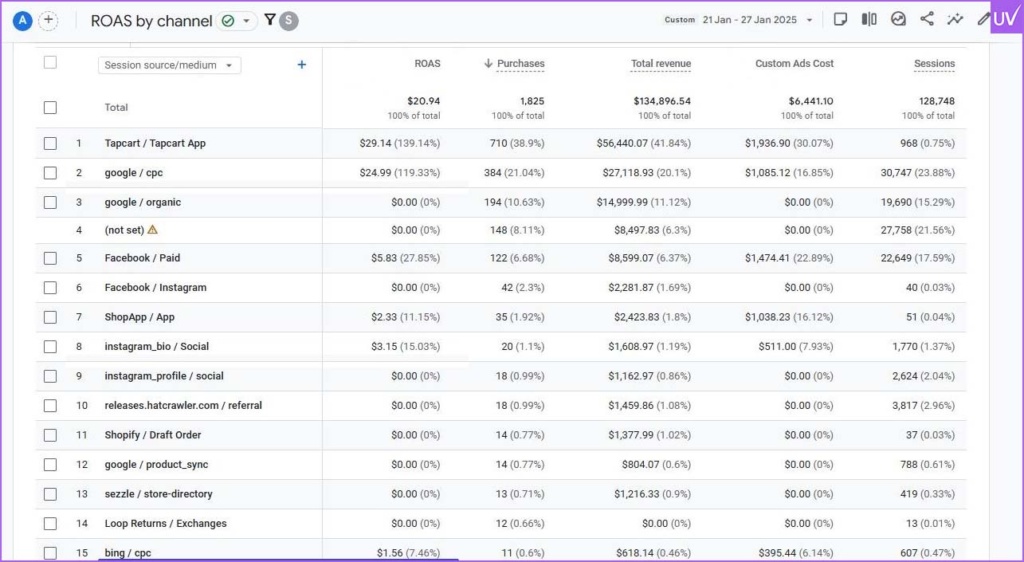
Let's go over the basics, but not in a way that makes it sound like a dictionary definition.
Return on Ad Spend is what ROAS stands for.
At its core, it answers one simple question:
How much money do you make for every rupee you spend on ads?
That's all.
Your ROAS is 4 if you spend $1 and make $4.
It's just math. Clean metric. Simple to keep track of.
But this is where most explanations stop, and the confusion starts.
ROAS tells you one powerful thing:
- How effectively your ads are turning spend into revenue
And for performance marketers—that’s everything.
It only tells you one thing: how well your ads are making money.
That's why ROAS became such a big deal in digital marketing.
ROAS is directly related to money, unlike clicks, impressions, or even conversions. It's the closest thing marketers have to a "bottom-line metric" in ad platforms like Google Ads and Meta Ads.
That's why it's all over the place:
- ROAS in Google Ads dashboards
- ROAS in ads on Amazon
- Using ROAS as a key performance indicator in marketing
But here's the catch.
ROAS is the closest thing marketers have to a revenue truth inside ad platforms.
It's a sign, not the whole story.
When used correctly, ROAS can help you figure out where to spend more and where to spend less.
If you use it strategically, ROAS becomes your strongest lever for both optimization and scaling.
Before you get too worked up about improving ROAS, you need to know what it really means—and what it doesn’t.
ROAS Formula and Calculation
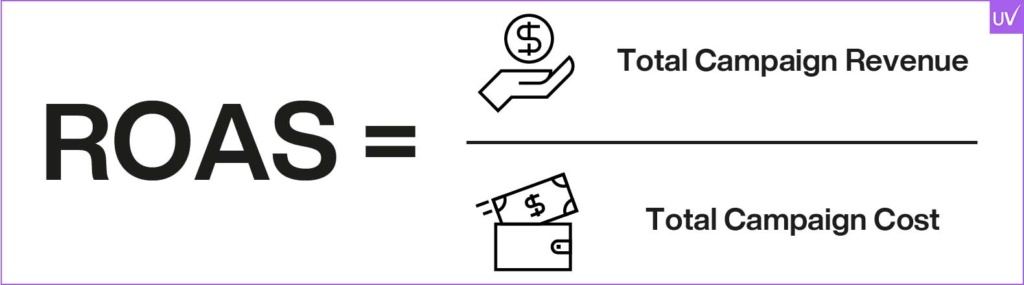
Let's talk about the formula. People often don't give it enough credit because it's so easy.
ROAS = Revenue / Ad Spend
No problems. No variables that aren't obvious. It's just a ratio.
Your ROAS is 4 if you spend $5,000 on ads and make $20,000 in sales. That means you get $4 back for every $1 you spend.
Sounds good, right?
Now let's take a step back.
This is where things start to go wrong.
Picture the same thing happening:
- Income: $20,000
- Cost of Ads: $5,000
- Price of goods: $10,000
- Shipping and handling: $4,000
You have $1,000 left.
Yes, your ROAS is still 4X.
But your real profit margin is very small.
And in many real cases, it's even worse.
That’s why mastering ROAS—not just measuring it—is what separates average marketers from high performers. It gives you a clear number, but not the whole story.
Tracking is another place where things go wrong.
Your ROAS isn't reliable if your conversion tracking is even slightly off. Ensuring accurate tracking helps marketers feel more assured about the trustworthiness of their data and their decision-making.
Then there's the problem of fake income:
- Including orders that were refunded
- Counting conversions that were the same
- Leaving out cancellations
All of this makes ROAS seem better than it really is.
So, yes, the formula is easy.
But it takes a little more discipline to get a real ROAS.
And if you don't get this part right, everything else that depends on it—optimization, scaling, budgeting—falls apart.
What Is a Good ROAS? Benchmarks, Averages, and Reality

When people question what constitutes a good return on assets (ROAS), they are actually searching for a benchmark, or a standard by which to evaluate performance.
It's likely the most frequently asked question on this subject, yet it's also one of the most deceptive.
Because a number is what everyone wants.
A standard.
Something to strive toward.
Frequently, you will hear:
- 3X is mediocre
- 4X is decent
- 5X+ is excellent
Indeed, that's not incorrect as a general rule.
Here's the issue, though.
Only in context does an "excellent ROAS" make sense.
For example, with a 30% profit margin, a 3.3X ROAS is just break-even, making 4X marginally profitable. Conversely, a high-margin product with 70% profit can sustain a 4X ROAS. Contextual benchmarks help you set realistic goals aligned with your margins.
Now contrast it with a high-margin product at 70%. Suddenly, that identical 4X ROAS appears to be in excellent health.
For this reason, benchmarks are just starting points—real performance comes from improving your own ROAS over time, and understanding industry-specific standards helps marketers feel more equipped to assess their true performance and set realistic goals.
We do get a broad idea from industry data. For instance:
- The typical eCommerce ROAS ranges from 3X to 5X.
- Due to lengthier sales cycles, B2B campaigns frequently have lower ROAS (2X–4X).
- Because lifetime value determines profitability, SaaS companies occasionally accept even lower initial ROAS.
However, these are guidelines rather than regulations.
The growing stage is another layer that people frequently overlook.
To attract clients and increase volume, early-stage brands may intentionally run at a lower ROAS. Conversely, established brands may aim for higher ROAS to safeguard profits.
Instead of asking “What’s a good ROAS?”
Ask: “What ROAS can I sustain while scaling profitably?”
The number that matters most is the one.
What Is a Good ROAS for E-commerce, Amazon, and B2B
Now let’s get specific—because “good ROAS” changes dramatically depending on where you’re playing.
E-commerce ROAS

You've undoubtedly heard this before if you manage an online store:
"A good ROAS is 3X to 5X."
Indeed, that is the average for the industry. Globally, the majority of eCommerce brands fall between 3.2X and 4X ROAS.
Here's what's really going on behind the scenes, though.
E-commerce is sensitive to margins. You have to cope with:
- Product prices
- Shipping
- Returns
- Discounts
- Platform fees
Therefore, depending on your cost structure, even a 3X ROAS can be break-even.
For this reason, a lot of scaling brands—and any experienced ecommerce PPC company—focus on:
- During growth phases, 2X–3X
- 4X+ in terms of profitability optimization
Achieving the ideal ROAS for your margins is more important than achieving the highest one.
Amazon ROAS
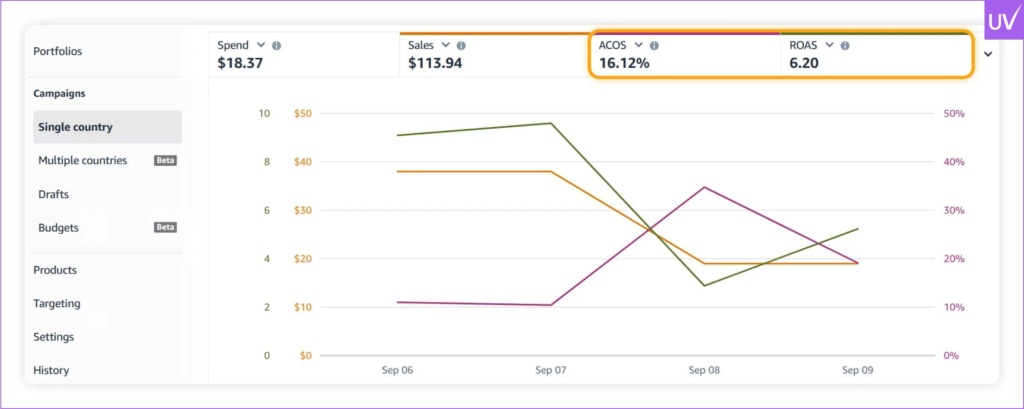
Amazon is a different champ.
There is more competition. There are always price wars. Additionally, consumers are already making purchases.
Typical ROAS for Amazon:
- 2X–4X
Not as good as eCommerce? Yes.
But it's also more focused on conversions.
Tighter margins are being exchanged for higher intent.
B2B ROAS
This is the point at which everything fully changes.
A "low" ROAS in B2B does not always indicate subpar performance.
Why?
Because the client's lifetime worth is what truly matters, not the initial conversion.
A campaign that includes:
- Over time, a 2X ROAS might become a 10X+ ROI.
Therefore, ROAS is frequently merely an entry metric rather than the ultimate decision-maker in B2B.
What is the takeaway?
ROAS behaves differently across industries—but its importance stays constant.
You will always misjudge your performance if you overlook that it operates differently across industries.
ROAS in Google Ads and Meta Ads: How Platforms Actually Use It
Let’s move from theory to execution—because ROAS becomes truly meaningful when you see how different platforms use it.
ROAS in Google Ads
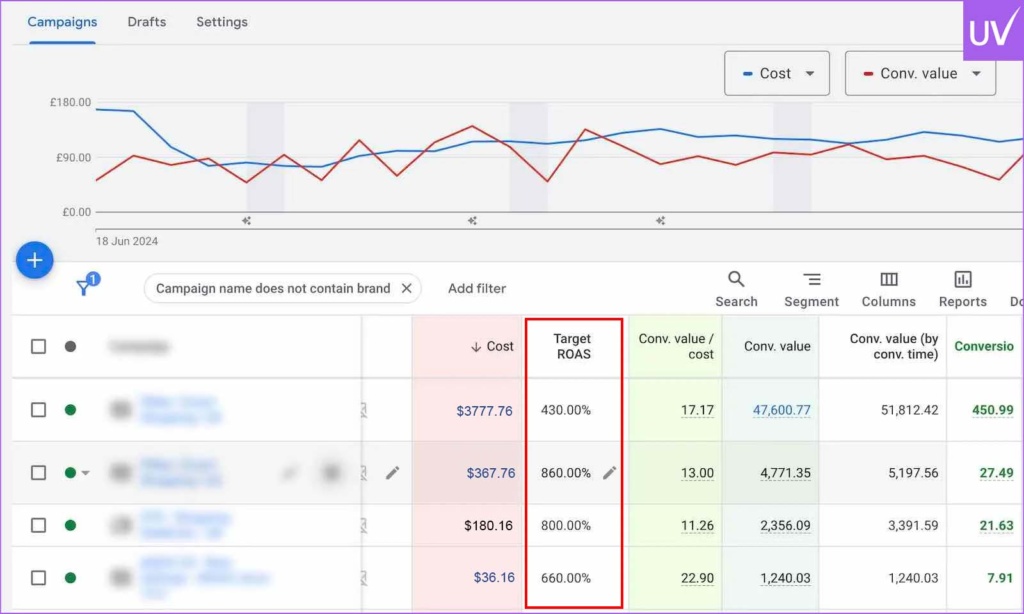
Most advertisers first encounter ROAS in Google Ads, particularly when using Target ROAS bidding. On the surface, it seems straightforward: you provide the desired return, and Google modifies offers to achieve that objective. However, it's doing much more under the hood.
Google predicts which clicks are most likely to generate higher revenue using past conversion data, user signals (such as device, location, and behaviour), and intent-based queries. It automatically raises or lowers bids in real time based on that prediction.
The problem is that Target ROAS is only effective when there is sufficient data. Before using value-based bidding, Google recommends having at least 30 to 50 conversions in the previous 30 days. Without it, performance becomes erratic, and the system struggles to make accurate predictions.
ROAS in Meta Ads
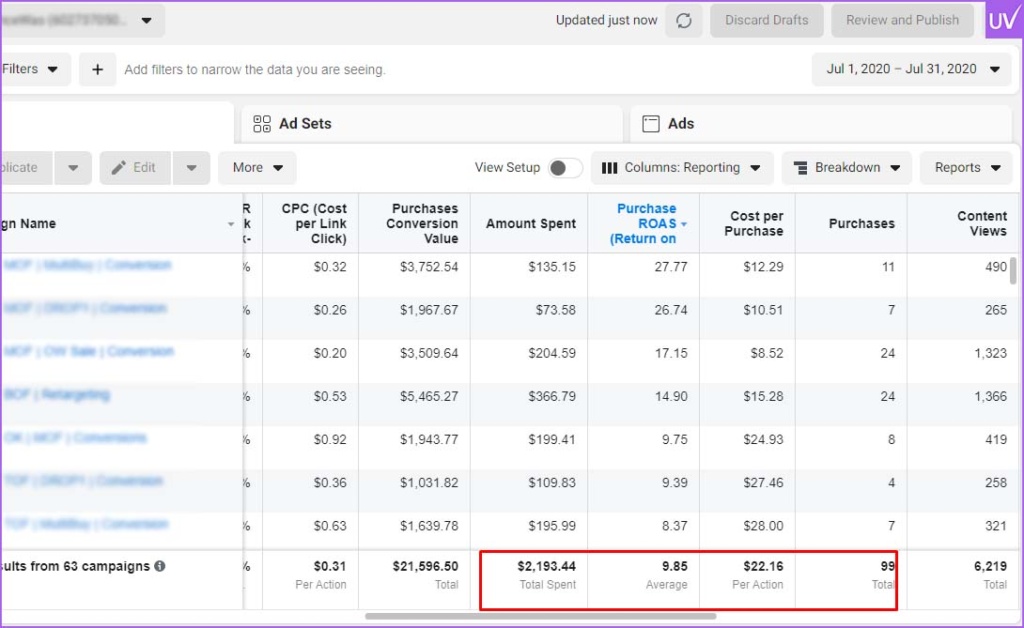
Let's now discuss Meta Ads, a topic many marketers find confusing.
Meta does not rely on clear search intent, unlike Google Ads. Users are scrolling rather than actively searching for things. This indicates that, in this case, demand creation drives ROAS more than demand capture does.
Setting a rigid "goal ROAS" isn't always necessary when using Meta Ads. Rather, it concentrates on maximizing conversion value by:
- Buy event monitoring
- Value-based optimization
- Audience signals
- Behavior
To put it simply, Meta prioritizes showing advertisements to users who are more likely to earn higher incomes.
Here’s the key difference between Google Ads vs Meta Ads ROAS:
- In Google Ads, you guide the system with a target ROAS
- In Meta Ads, you feed the system data, and it learns what “valuable” looks like
Meta doesn't inquire about your desired ROAS. It examines what works and attempts to replicate it on a larger scale.
It's important to recognize this distinction because using the same approach on both platforms often yields subpar results.
Target ROAS vs Target CPA: Which One Should You Use?
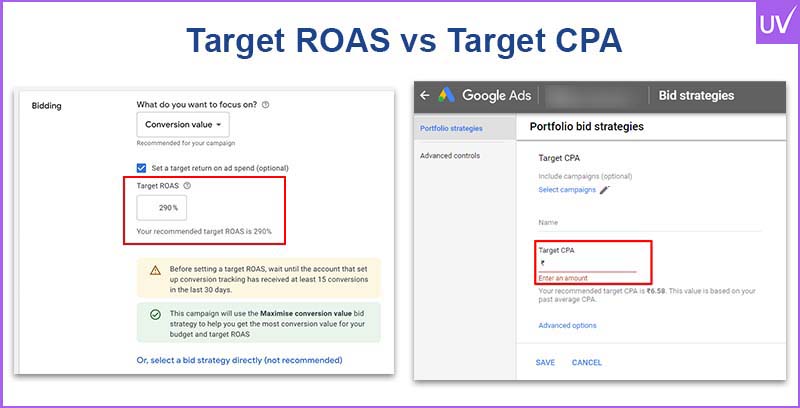
This is one of those choices that subtly influences whether your campaigns succeed or fail.
Let's make things simpler.
Target Cost Per Acquisition, or CPA, emphasizes:
- Obtaining conversions for a set price
Target ROAS is concerned with:
- Maximizing those conversions' revenue
When Target CPA performs better
- Campaigns to generate leads
- Conversions with fixed values
- Early-stage accounts with scant information
CPA keeps things straightforward if each conversion is about equal in value.
When it makes more sense to target ROAS
- E-commerce companies
- Changing prices
- Various product margins
Since not every conversion is created equal.
ROAS is aware that selling a $500 product and a $5,000 product shouldn't be handled the same.
The real difference
CPA Asks:
"How cheaply can I obtain in conversions?"
ROAS Asks:
"What is the value of those conversions?"
You could optimize perfectly—for the wrong result—if you select the incorrect one.
How to Measure ROAS Accurately
The majority of marketers won't acknowledge this:
Your ROAS is likely not entirely correct.
It's not because you're doing something incorrectly, but rather because tracking isn't flawless.
- Where errors originate from attribution models (data-driven vs last-click)
- Behavior across devices
- Cookie restrictions
- Difference in platform reporting
It is typical to observe:
- Google Ads with a 4X ROAS
- Analytics displaying 3X
- Backend income displays a completely different image
The impact
According to studies, attribution discrepancies can distort ROAS by at least 30%.
That is a significant distinction that can influence a decision.
What you should concentrate on instead
Perfection is not as important as consistency.
- Use a single primary attribution approach.
- Keep an eye on patterns rather than just numbers.
- Verify data regularly
Practical Mindset Shift
ROAS is a directional but extremely powerful performance signal.
Use ROAS to guide every major optimization and scaling decision.
What Actually Impacts ROAS

Many marketers believe that ROAS is managed within the advertising platform. Performance improves when bids, budgets, and targeting are adjusted.
In actuality, ROAS is the result of your marketing system as a whole.
Additionally, several platforms highlight certain levers.
For instance, consider creative quality.
Creative thinking is crucial with Meta Ads. Users are being interrupted rather than actively seeking. Your advertisement must halt the scroll, convey value right away, and prompt action within seconds. Regardless of how well you target, ROAS quickly declines if the creative fails.
The dynamic is different in Google Ads. The user is already looking for something, thus they have intent. Therefore, ROAS depends more on how well your landing page copy, ad copy, and keywords support that goal.
Targeting comes next.
Targeting on Meta is based on audience signals, interests, and behavioral trends. Keywords and search queries are what drive targeting on Google. Poor targeting leads to wasteful spending in both cases, but the processes differ.
On both platforms, landing pages, prices, and offers are also quite important. The best advertisement cannot redeem a poor conversion experience. Additionally, enhancing ROAS sometimes has more to do with how your product is positioned than with advertisements.
Here, the crucial change is this:
ROAS reflects your entire marketing system—from ad to conversion.
You will reach a ceiling if you attempt to address it solely within the ad platform. Improving the entire process, from initial impression to final purchase, yields the true benefits.
How to Maximize ROAS
The ultimate objective seems to be maximizing ROAS. However, if you push it too far, it may actually impede your progress.
This is the reason.
Playing it safe—focusing exclusively on nearly certain conversions, avoiding wider reach, and targeting smaller, high-intent audiences—usually results in higher ROAS. This increases efficiency, but it restricts size.
You eventually reach a ceiling.
Therefore, the real objective is maximizing ROAS while scaling spend. The goal is to strike a balance between growth and efficiency so that your efforts are both profitable and scalable.
This is how something appears in real life.
Let's start with your conversion rate. This is one of the quickest strategies to raise ROAS without going over budget. Revenue per click can be greatly increased by making even minor changes to your landing site, checkout process, or messaging.
Next, concentrate on audiences with high intent. Conversion rates are significantly greater for users who are already familiar with your brand, such as website visits, cart abandoners, and repeat customers. Retargeting efforts frequently yield ROAS that is two to three times more than cold traffic.
Segmentation is the next step.
Not every product works the same way, and not every user acts in the same manner. You have considerably more control over where your money is spent when you segment high-value clients, recurring customers, and new users into distinct campaigns, which directly affects ROAS.
Platform differences start to matter at this point.
Enhancing ROAS in Google Ads mostly involves more effective intent capture. This entails improving your bidding tactics, honing your keywords, and ensuring that your landing pages are relevant to user searches.
The game is different in Meta Ads.
No current search intent is present. Your advertisement must generate interest from the outset. This indicates that your largest lever is creative rather than targeting. No matter how perfectly everything else is set up, your ROAS will decline if your ad doesn't immediately stop the scroll and convey value.
Because of this, a tactic that works on Google frequently doesn't work on Meta.
- Google captures demand.
- Demand is generated and filtered by Meta.
And that must be reflected in your strategy.
Lastly, scale while maintaining control. Budget increases made too rapidly can impair performance and reduce efficiency. Allow your campaigns to stabilize, collect data, and then grow progressively.
Because maximizing each click isn't ultimately what ROAS is all about.
The goal is to create a system that can expand without failing.
Common ROAS Mistakes That Quietly Kill Performance
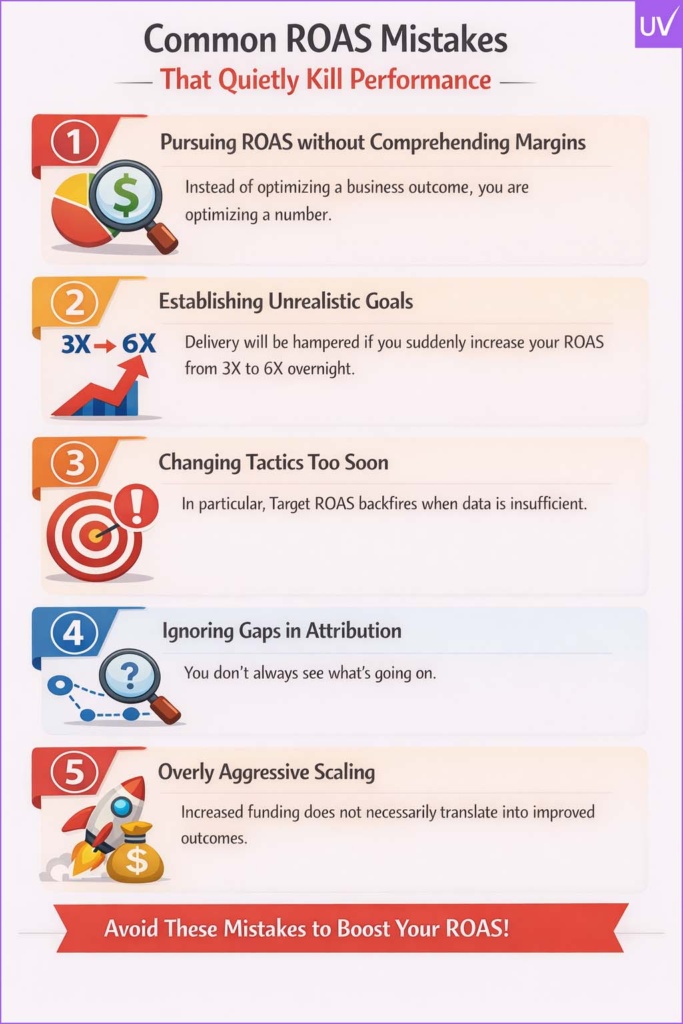
Let's identify the typical suspects.
1. Pursuing ROAS without comprehending margins
Instead of optimizing a business outcome, you are optimizing a number.
2. Establishing unrealistic goals
Delivery will be hampered if you suddenly increase your ROAS from 3X to 6X overnight.
3. Changing tactics too soon
In particular, Target ROAS backfires when data is insufficient.
4. Ignoring gaps in attribution
You don't always see what's going on.
5. Overly aggressive scaling
Increased funding does not necessarily translate into improved outcomes.
The fundamental problem
Most ROAS issues are not technological.
They are tactical.
Advanced Concepts: Marginal ROAS and Incremental ROAS
If you want to go beyond surface-level optimization, this is where things get interesting.
Marginal ROAS
This measures:
How much more money do you make from spending more on advertisements
Marginal ROAS typically decreases as you scale.
Why?
Since you are relocating from:
- High-intent users to more diverse,
or
- Unqualified audiences
Incremental ROAS (iROAS)
This focuses on:
What revenue is actually generated by advertisements versus what would have occurred regardless,
Not all conversions are "caused" by advertisements.
A few individuals had already made purchases.
Why this matters
These measurements assist you in providing an answer at scale:
- Do we genuinely promote growth?
- Or simply meeting current demand?
Conclusion: Master ROAS to Scale Smarter
If there's one lesson to be learned from all of this, it's straightforward:
ROAS isn’t just a metric—it’s the foundation of performance marketing.
Yes, it is helpful, but only if you read it from the proper perspective.
Because a 5X ROAS can be unprofitable.
A 3X ROAS may fuel serious growth.
Furthermore, focusing on raising that figure without knowing what's causing it will quickly lead you in the wrong direction.
The best brands don’t just track ROAS—they scale it, protect it, and compound it. They use it as a tool for making decisions.
They pose more insightful queries:
- Does this ROAS match our profit margins?
- Do we optimize for long-term growth or short-term efficiency?
- If we scale this, what will happen to profit and revenue?
Real performance begins with that change—from chasing data to comprehending it.
ROAS in marketing ultimately has nothing to do with how effective your advertisements appear.
It's about how well your whole system—ads, creatives, funnel, and pricing—works together to generate meaningful revenue.
We at Uvisible do more than simply optimize ads to "increase ROAS."
We consider the wider picture:
- Where your actual revenue is coming from
- What's restricting your scale
- How to strike a balance between growth and efficiency
We assist brands in going beyond speculation and creating scalable solutions, from Google Ads and Shopping campaigns to full-funnel performance planning.
Therefore, Uvisible can assist you in doing it correctly if you're prepared to go there.
FAQs
What does ROAS mean in marketing, and why is it important?
The amount of revenue your advertisements generate per unit of expenditure is measured by ROAS (Return on Ad Spend). It is a crucial performance indicator in digital marketing that guides budget allocation and assesses campaign effectiveness. ROAS is more than just a figure for firms; it directly impacts revenue strategy and scaling choices.
What is considered a good ROAS for Google Ads and Meta Ads?
Although this benchmark varies by industry, margins, and growth stage, a decent ROAS typically ranges from 3X to 5X. Due to their strong search intent, Google Ads frequently deliver higher ROAS, whereas Meta Ads may start lower because they focus on generating demand. A ROAS that aligns with your profitability, rather than merely industry averages, is ideal.
How do you calculate ROAS accurately?
Revenue from advertisements is divided by the total amount spent on advertisements to determine ROAS. Businesses should use net revenue (after discounts and returns) and account for all related advertising expenses for accurate insights. Without these modifications, a simple ROAS calculation may overestimate performance.
What is the difference between ROAS and ROI?
While ROI (Return on Investment) evaluates total profit after all business expenses, ROAS analyzes the effectiveness of advertising income. While ROI offers a more comprehensive picture of financial success, ROAS is utilized for campaign-level optimization. A high ROAS does not always indicate a profitable campaign.
How can businesses improve and scale ROAS effectively?
Optimizing the entire funnel—not just ad spend—is necessary to increase ROAS. This includes enhanced landing pages, better targeting, higher conversion rates, and better creatives (particularly for Meta Ads). Businesses using advanced PPC services often scale faster by combining data-driven optimization with strategic budget allocation. Businesses must strike a balance between ROAS and volume to scale successfully, rather than focusing solely on efficiency.
About us and this blog
We are a digital marketing company with a focus on helping our customers achieve great results across several key areas.
Request a free quote
We offer professional SEO services that help websites increase their organic search score drastically in order to compete for the highest rankings even when it comes to highly competitive keywords.
Subscribe to our newsletter!
More from our blog
See all posts