
The Internet Is Flooded — and Google Is Filtering Harder Than Ever
The internet is overflowing with AI content in 2025, and there is no polite way to put it.
From individual creators to large marketing teams and AI services companies, everyone is producing articles, landing pages, and SEO blogs more quickly than a caffeine-fueled newsroom. With a few cues and an overconfident AI tool, writers can now complete tasks that once took two days in twenty minutes.
Here's the unexpected twist, though:
AI did not destroy content.
Content exposed by AI.
It revealed which companies were using flimsy SEO strategies. Websites that were publishing for keywords rather than users were made public. The top five ranking pages revealed writers piecing together generic lines.
Additionally, it revealed that, long before artificial intelligence (AI) came into play, "content at scale" had been subtly degrading the quality of the web.
Google foresaw the impending flood and strengthened its defenses.
The new search ecosystem does not oppose AI. It is opposed to mediocrity.
SEOs need to rethink their entire content pipeline if they want to survive in 2025. Not only how content is produced, but also how depth is established, credibility is shown, and experience is validated. Algorithm gaming is no longer the focus here. It's about lining up with them.
Let's take a thorough, unique deep dive and dissect this layer by layer.
Google's True Opinion on AI Content Is More Complex Than Anyone Acknowledges
Google's public position is misleadingly straightforward: "As long as it is helpful, AI-generated content is allowed." In the context of AI content and Google guidelines, however, the actual narrative, as presented in SERPs daily, is much more intricate.
However, the actual narrative, as presented in SERPs daily, is much more intricate.
Google is not attempting to determine if a piece of content was produced by a language model or typed by a human. Instead, it assesses whether the information conveys depth, intention, and lived understanding. Google distrusts generic, templated, indistinguishable content that seems mass-produced, not artificial intelligence.
The way a teacher assesses essays—looking for uniqueness, coherence, relevance, and contextual richness—is now how the algorithms examine writing.
If the content includes predictable transitions, repetitive sentence structures,
Regardless of whether a human or an AI produced the content, Google assumes that it was produced without actual expertise if it contains brief explanations or generalizations without supporting evidence or subtleties.
That is the actual difference.
Google penalizes the lack of human insight rather than machines.
Because of this, blogs that employ AI to boost velocity without contributing content are dropping out of the rankings. Teams that integrate AI with human research, analysis, and field experience are expanding more quickly than ever before.
The issue is not AI.
Without experience, AI is.
The Unspoken Dangers of AI Content and Why Most Websites Ignore Them

The majority of marketers are concerned about "AI detection," but they are oblivious to the true threats to SEO.
1. AI Generates Linguistic Patterns That Give Content a Manufactured Appearance
Massive datasets are used to train large language models. Because of this, their writing frequently has a distinct rhythm:
Paragraphs that are too structured
Sentences with balanced but uninteresting construction, predictable transitions like "Moreover" and "In conclusion," and no narrative breaks
Even though it reads well to humans, Google finds this "statistically perfect" writing to be robotic.
These trends are flagged as indicators of scaled content by Google's quality filters, which were also heavily updated in 2024. Not because it's artificial intelligence (AI), but rather because it lacks individuality, creativity, and any trace of a voice—something becoming even more critical as GEO replacing SEO becomes the industry debate.
2. AI Removes Brand Personality Without Meaning To
Each brand has a unique set of linguistic cues that set it apart from rivals. These tend to be flattened into neutral, business-friendly tones by AI. Your brand loses its emotional resonance and punch the more you rely on AI.
- Its distinctive voice
- Rankings become brittle when your content could have been written by anyone.
AI frequently undermines brand tone, which is now a valuable SEO asset.
3. AI Fails at What Google Values Most: Firsthand Experience
Regardless of how sophisticated GPT gets, it cannot:
- Test a product and conduct a customer interview
- Experiment.
- Examine a dashboard.
- Attend an event, use software, make a mistake, and then share the lesson you learned.
Since firsthand insights enhance the quality of content and AI is unable to generate them authentically, Google is increasing its focus on them.
For this reason, "generic advice"-filled content is being filtered out.
The reason behind the explosive growth of blogs featuring data-driven observations, founder commentary, personal stories, and actual screenshots.
4. The Compliance Risk Nobody Talks About
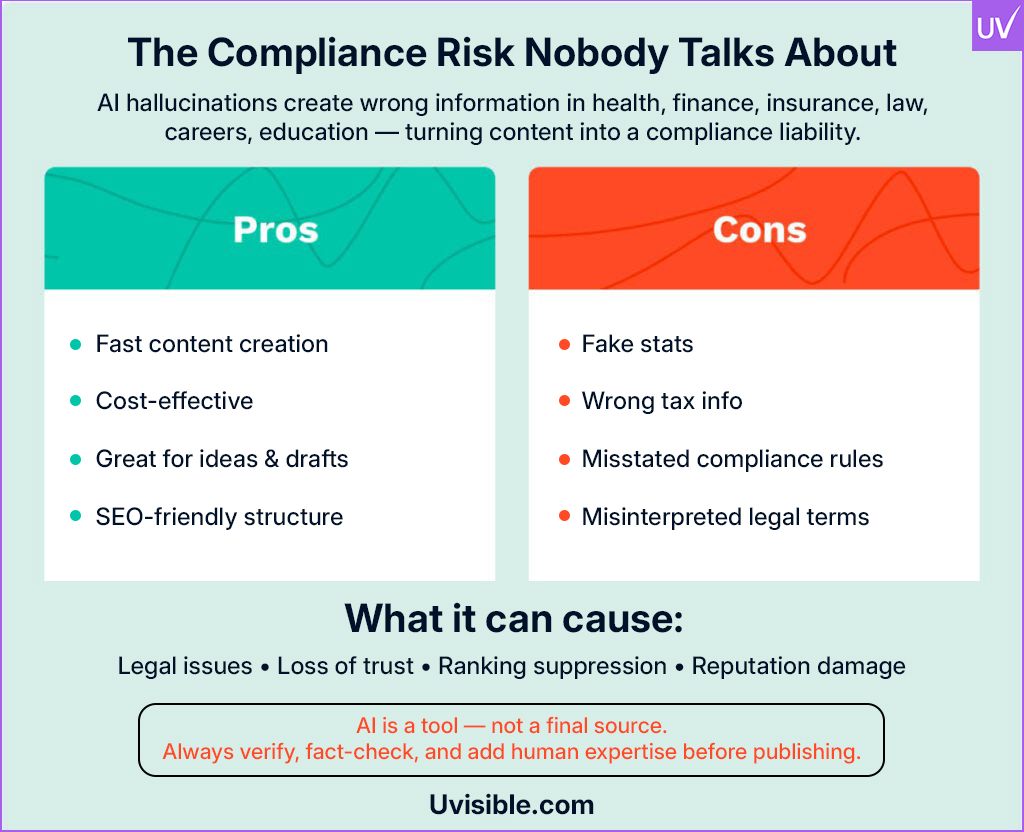
Artificial intelligence (AI) hallucinations are serious errors in fields like health, finance, insurance, law, careers, plumber digital marketing, and education. They are a liability.
An AI instrument could:
- Create medical statistics
- Overstate tax exemptions
- Misrepresent the rules for compliance
- Misunderstand legal terminology
Companies that publish false information produced by AI run the risk of:
- Legal concerns
- Decline in user confidence
- Suppression across the domain
- Harm to one's reputation
The risks are too great to depend solely on text produced by machines.
The Moral Obligation of AI Content (And Why Brands Can't Ignore It)
Although ethics may seem like a sensitive subject, it is increasingly being used as a technical ranking factor in SEO, especially in areas like SEO for SaaS companies.
Google's systems search for indicators of responsibility. Users also do.
Openness Fosters Trust
Nobody expects brands to claim that GPT-5 wrote this blog.
However, they do anticipate:
- Author names, credentials, and a human review of their expertise
- This is no longer optional.
- Google's trust model includes user trust.
Accuracy Requires Human Verification
- AI is not a truth engine; it is a pattern generator.
- Numbers must be verified by human editors.
- Historical allusions, quotations, brand assertions, and compliance-sensitive guidance
- This human layer is an ethical necessity, not a luxury.
Active Monitoring of Bias Is Necessary
AI is biased because it draws from the internet:
- Geographic
- Cultural
- Gender-based
- Professions
To make sure that content is inclusive, equitable, and nuanced, brands need to implement ethical oversight.
- AI is a tool.
- The compass is ethics.
The Unmatched Opportunities AI Unlocks for Smart SEOs
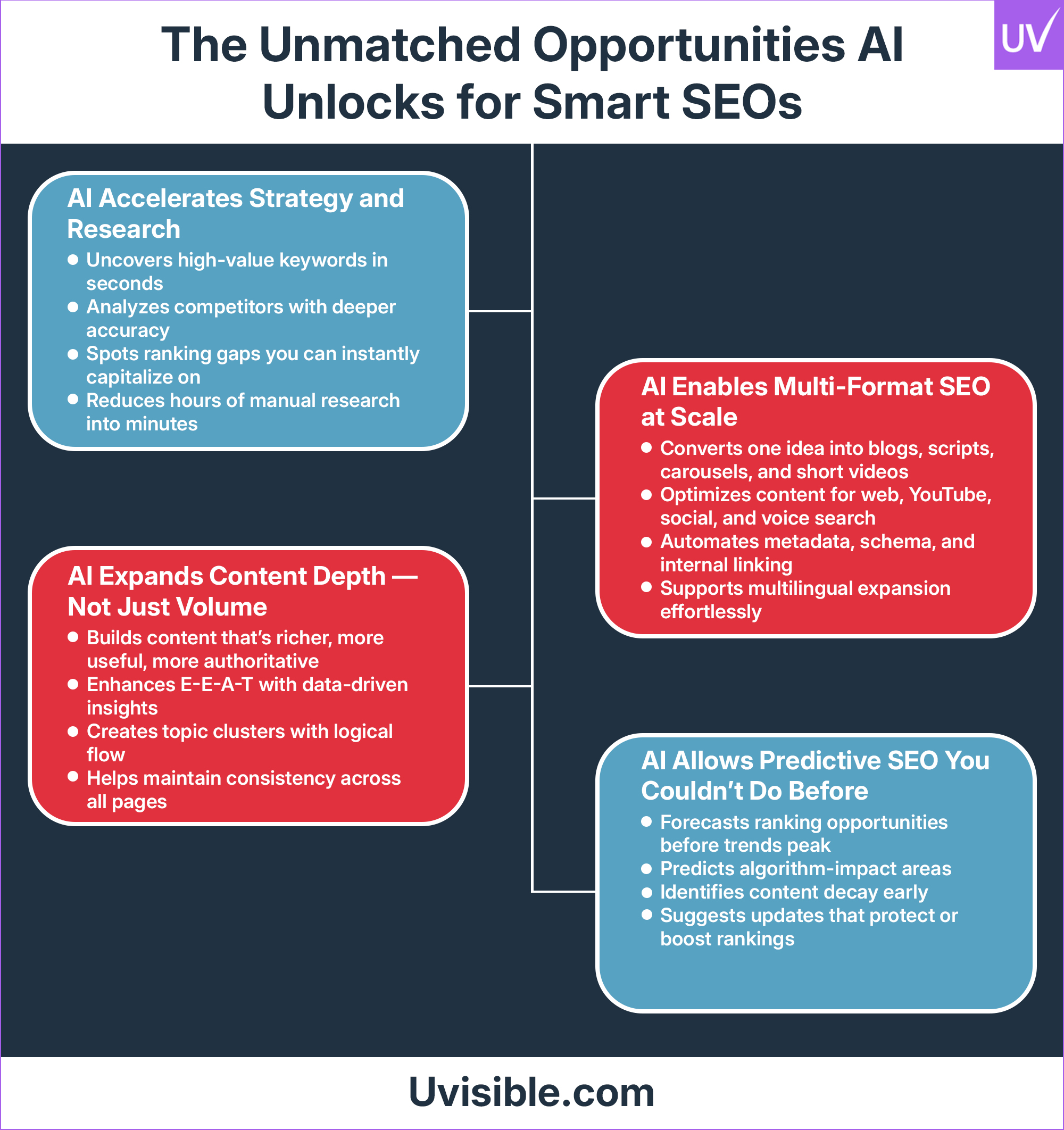
AI is a once-in-a-generation advantage for teams that know how to use it, despite all of its risks.
AI Accelerates Strategy and Research
Before AI, competitive analysis, SERP mapping, and keyword clustering took hours or even days.
Presently:
- 300 SERPs from 3 SERPs
- 2,000 variations of 10 keywords
- 500-page content maps from five competitor pages
within a few minutes.
As a result, decisions are made more quickly and intelligently and are based on data.
AI Expands Content Depth, Not Just Volume
The idea that AI is a writing tool is among the most pervasive misconceptions.
As a tool for thought, it is far more useful.
AI is capable of:
- Combine difficult ideas
- Find the missing angles and connect the research dots.
- Present opposing perspectives.
- Extend concepts that aren't fully developed
This is then further refined by human editors into original, highly authoritative insights.
AI Enables Multi-Format SEO at Scale
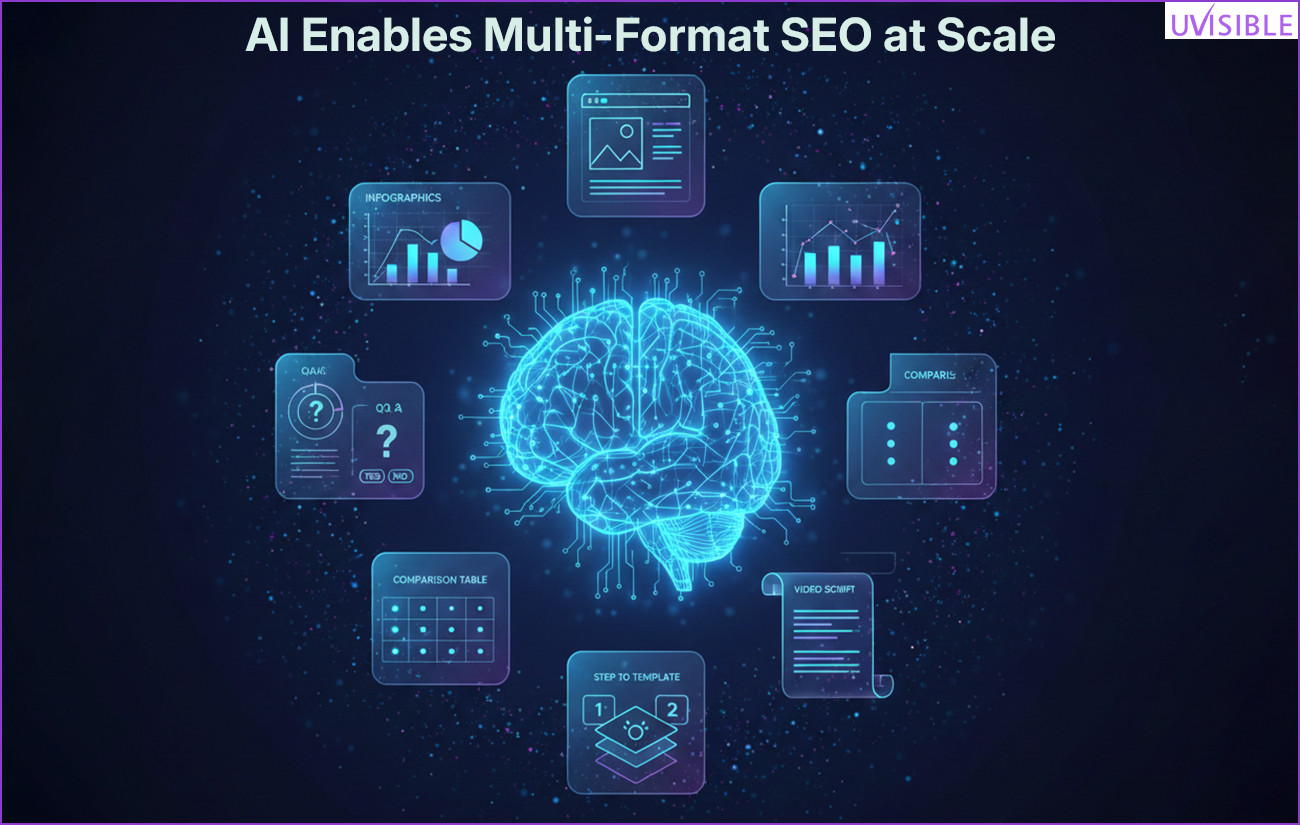
Blogs aren't the only aspect of modern SEO.
The topic is
- Infographics
- Interactive Q&A blocks
- Comparison tables
- Video scripts
- Schema-rich excerpts
- Templates for how-to
AI boosts creativity while significantly cutting down on production time.
AI Allows Predictive SEO You Couldn’t Do Before
AI can predict which keywords will trend and which pages are at risk if it has access to sufficient SERP data.
Which rivals are gaining ground, and how Google is changing its strategy
As a result, SEO moves from reactive to proactive optimization.
The 2025 Gold-Standard Process: Where AI and People Collaborate to Establish Authority

By 2025, the top-ranked brands will have a hybrid pipeline that looks like this:
- AI manages the research, including SERP patterns, competitor insights, and topic clusters.
- Humans contribute intelligence through data, screenshots, stories, and experience.
- AI drafts and structures synopses, extensions, and rebuttals
- Storytelling, tone, depth, and personality are all refined by editors for voice.
Discoverability is engineered by SEOs using snippet optimization, internal links, and schema.
What Google rewards is the result of this workflow:
- High-quality, user-focused content that is supported by experience.
- AI and humans are not at odds.
- It's human + AI versus subpar content.
The Future of AI Content and Search
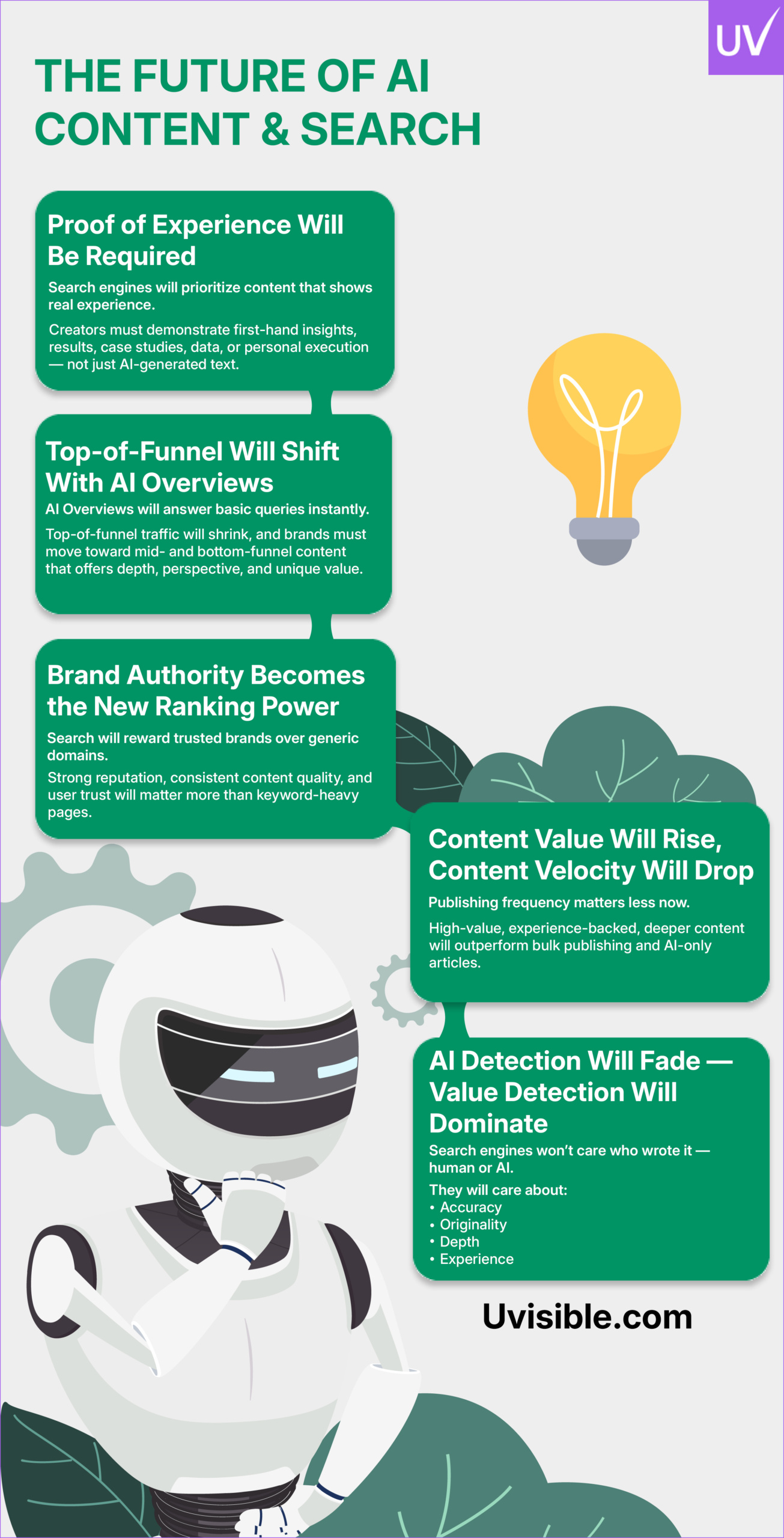
Based on recent Google trends rather than conjecture, this is the direction things are going.
Proof of Experience Will Be Needed for the Search
Not assertions.
Evidence.
- Screenshots
- Actual images
- Proof of use
- User-generated commentary.
Top-of-Funnel Will Change Due to AI Overviews SEO
"Search without searching" is Google's direction.
Brands need to focus on providing succinct, well-organized, and explanation-first responses.
Brand Authority Will Take the Lead Authority for Domains
Google is giving priority to:
- Reputation and proficiency
- Consistency
- Signals of trust
- Authority cannot be created by AI.
You deserve it.
Content Value Will Increase, Content Velocity Will Decline
Publishing five outstanding blogs will outperform publishing fifty mediocre ones.
AI Detection Will Be Replaced by Value Detection
"Was this written by AI?" is not a question Google will ask.
"Does this content add value beyond what AI can produce?" Google will inquire.
That's what lies ahead.
AI Is Not Replacing SEOs — AI Is Replacing Low-Quality SEO
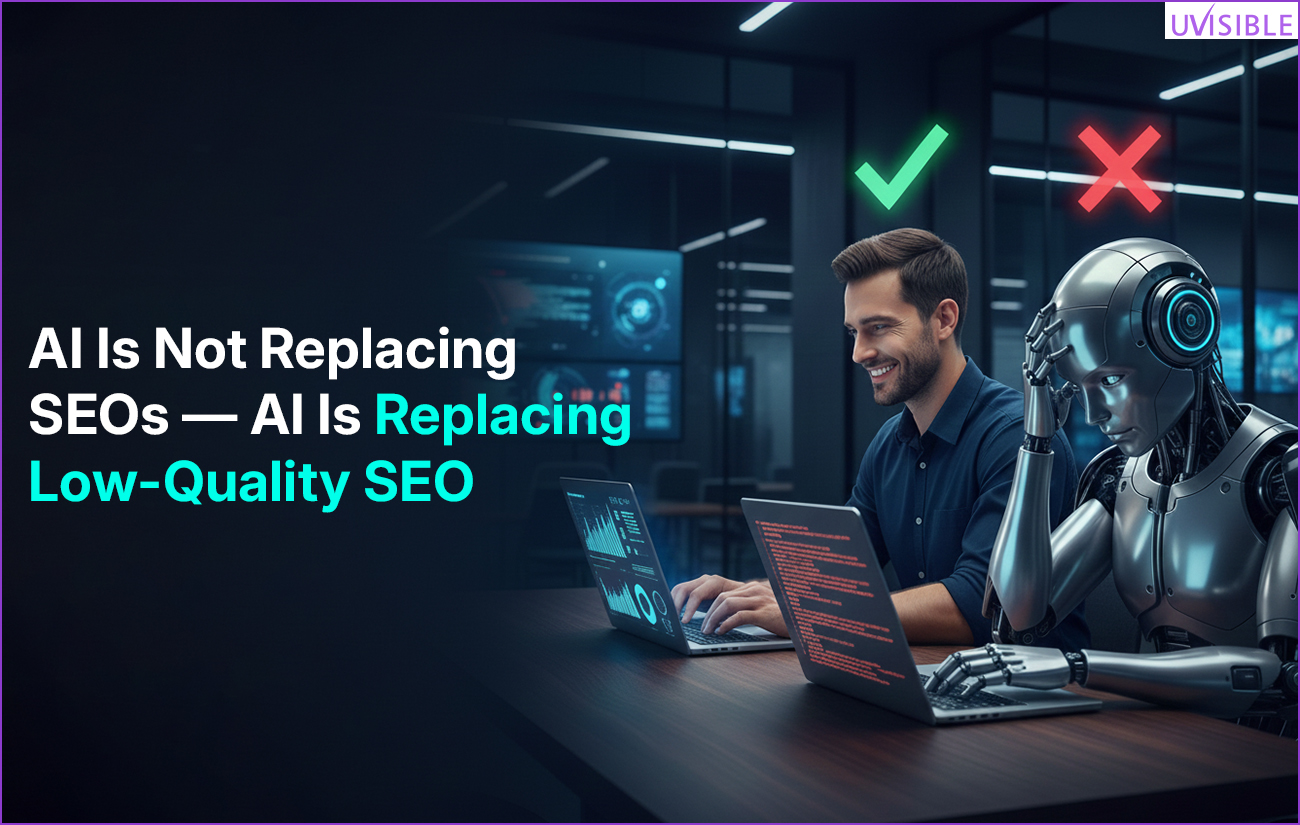
The landscape of SEO has changed irrevocably.
Content made just for keywords is no longer relevant.
Experienced, perceptive, and purposeful content is highly effective.
- AI is your helper.
- Your accelerator is AI.
- Your research engine is AI.
However, the ranking factor that Google cannot duplicate or replace is YOU — your knowledge, your experiences, your narratives, and your analysis.
Whether you’re in-house or working with an outsourcing SEO agency, the advantage still comes from the human brain.
AI won't scare astute SEOs.
AI will be used by astute SEOs to create the kind of content that only people can imagine.
The next ten years of search will be dominated by companies that combine human intelligence with machine efficiency.
Scale Smarter. Rank Faster. Build Authority With Uvisible.
If you're prepared to construct:
- SEO pipelines driven by AI
- Happy with real E-E-A-T
- A future-proof authority engine
- A brand voice that rivals can't be copied
- An ethical and sustainable approach to content
Your growth partner is Uvisible.
Together, we can use AI to your advantage in a morally sound, astute, and financially successful manner.
About us and this blog
We are a digital marketing company with a focus on helping our customers achieve great results across several key areas.
Request a free quote
We offer professional SEO services that help websites increase their organic search score drastically in order to compete for the highest rankings even when it comes to highly competitive keywords.
Subscribe to our newsletter!
More from our blog
See all posts






Recent Posts
- How SEO Works in Bing (And Why Ignoring It Might Be Costing You More Than You Think) February 27, 2026
- Things Every Website Should Have: The Complete SEO Blueprint February 14, 2026
- Digital Marketing Conferences 2026: Top Global Events for Marketing Leaders February 7, 2026