
AI Content & Google’s Search Landscape: Risks, Ethics & Opportunities for SEOs
- November 15, 2025
- SEO
AI Just Shook the SEO World—Now What?
Let's face it, artificial intelligence hasn't just knocked on the door of SEO anymore; it's snatched a chair and begun producing content more quickly than the majority of us can type "keyword density."
Every reputable marketer, including ChatGPT, Gemini, Jasper, and others, has experimented with AI content at some point. Here's the crucial query, though:
What is Google's actual approach to AI-generated content in SERPs, citations, and rankings?
SEOs have had a love-hate relationship with automation for years. Everyone was terrified when AI first appeared, thinking that Google would punish them.
"It's not about who or what writes it; it's about whether it's helpful and people-first," Google then casually revealed.
Suddenly, the regulations were altered.
If done correctly, AI content can now rank, convert, and establish authority. However, if done incorrectly, it can also destroy your visibility. AI writing tools can be helpful.
Let's examine the complex relationship between Google's algorithms, AI content, and SEO ethics and determine how SEOs can use this to their advantage.
How Google Really Handles AI-Generated Content
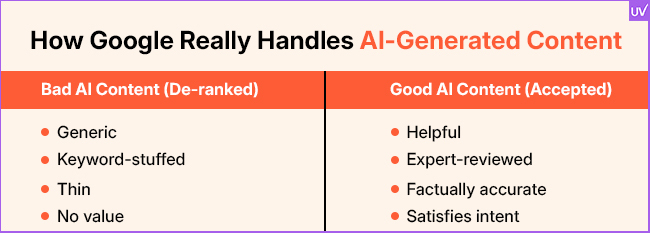
Does Google Penalize AI-Generated Content?
The short answer is no.
In a nutshell: It depends.
Google's official position is surprisingly relaxed:
"Using AI doesn't go against our rules. The caliber and purpose of the content are what count.
This implies that while AI-generated content isn't always bad, "spammy, lazy, or low-value" content certainly is.
Indeed, a 2024 survey by Search Engine Journal found that 58% of SEOs currently use AI tools to create content, and 72% believe that when properly optimized, those pages perform on par with or better than those created by humans alone.
And this is where AI SEO services actually matter. They don’t just help your pages rank in Google; they improve how your content appears across AI-driven platforms like ChatGPT, Google AI Overviews, and Perplexity. These systems rely heavily on structured, high-quality, well-optimized information—exactly what good AI SEO delivers.
The lesson learned?
Only when edited, enhanced, and fact-checked by humans who are aware of context and audience intent can AI content rank like a rock star.
How Does Google Evaluate AI Content for E-E-A-T?
E-E-A-T stands for Experience, Expertise, Authoritativeness, and Trustworthiness, and it's the acronym that SEOs should have permanently inked on their forearms.
Whether your post was written by a human or a parrot makes no difference to Google. It is concerned with providing a genuine experience, feeling human, and resolving actual user issues.
AI cannot accomplish that on its own. Expertise can be imitated, but not lived. This is why even a content marketing agency still relies on human insight to make AI-generated content actually meet Google’s standards.
Thus, your AI-powered approach ought to resemble this:
- Use AI for structure, ideation, and grammar.
- Include your data, anecdotes, or experiences.
- Check sources and facts.
- Add empathy and a human tone.
That's how you transform boring paragraphs into content that makes sense.
The “AI Citing AI” Loop: When Search Gets Stuck in a Feedback Spiral
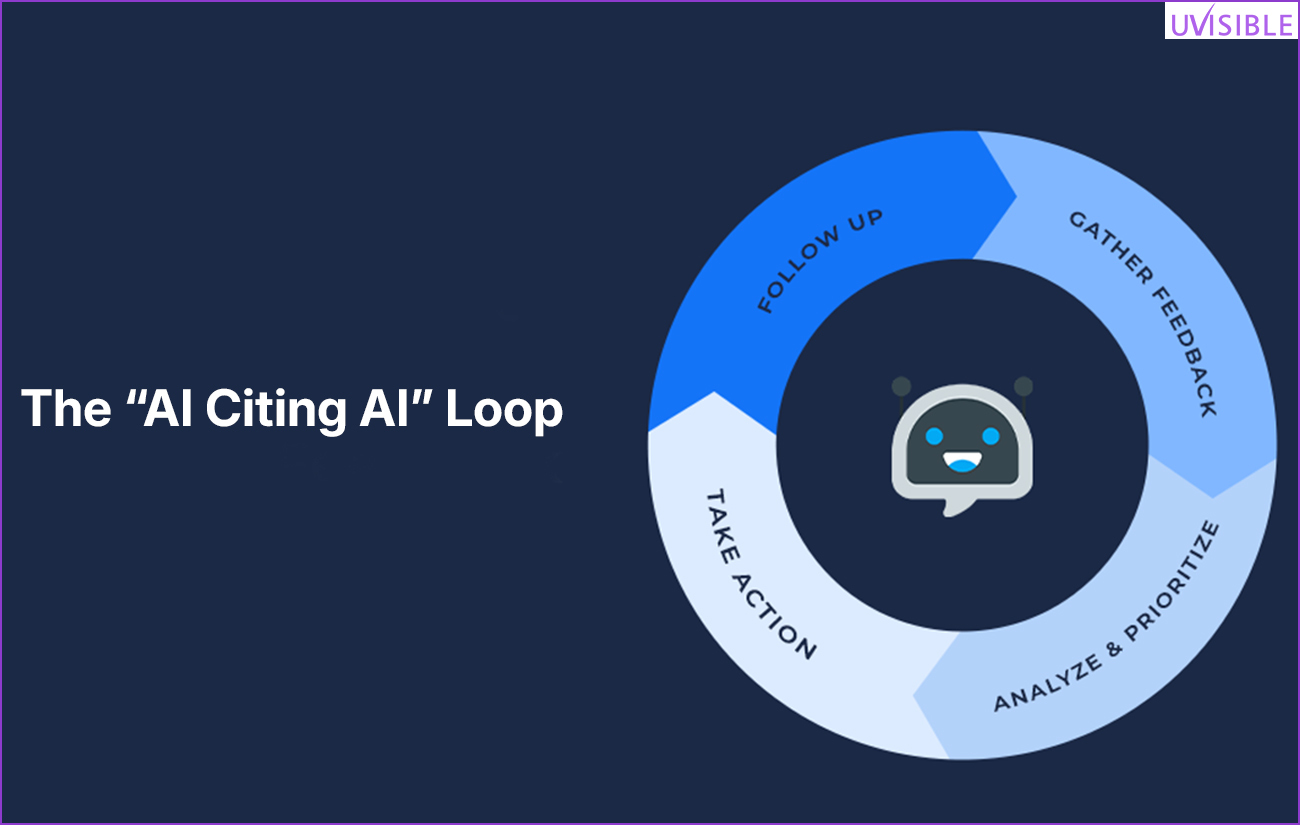
Things start to get spooky here.
Imagine this: Google's AI overview references the summary in search results after an AI tool scans the web, reads blogs written by AI, and summarizes them.
There you have it: AI citing AI. The internet is filled with semi-original fluff that is self-referential.
Already, this "AI echo chamber" is becoming a bigger SEO nightmare, especially as the landscape shifts into SEO vs AEO vs GEO battles for visibility.
Already, this "AI echo chamber" is becoming a bigger SEO nightmare.
New AI systems may wind up training on the same recycled data if the majority of the top-ranking content is AI-written, which would reduce overall originality and quality.
According to a 2025 study by Originality.ai, AI-generated content now appears in 46% of the top 100 search results in competitive niches. That's crazy, but dangerous. Google has no reason to rank you higher than others when everyone is saying the same thing.
What is the solution, then?
Bring in a new viewpoint. Include actual data. Incorporate human feeling.
To put it another way, include something that AI cannot duplicate.
The Ethics of AI Content: Is “Robot Writing” Cheating?
Let's address the most pressing issue:
Is it unethical to use AI for SEO?
No. Only when you use it carelessly or dishonestly is it unethical.
AI isn’t a ghostwriter. It’s a tool. It can brainstorm, outline, summarize, and polish, but you still have to be the creative brain behind quality blog content.
This is the morally ambiguous area:
- Passing off content that is entirely artificial intelligence as your "expert opinion."
- Disseminating false information without human confirmation.
- AI is being used to manipulate the algorithm rather than assist readers.
You're feeding the AI swamp that Google is attempting to drain, so congratulations if you're guilty of any of these.
On the other hand, companies that strategically and openly use AI are succeeding. They employ it for effectiveness rather than dishonesty. They reveal AI support. They maintain the voice of their brand.
Therefore, embrace AI rather than be afraid of it.
"Hey, we use AI to speed up research—but every piece is reviewed, fact-checked, and refined by real experts," you should explain to your readers.
Honesty like that fosters trust, and Google values trust.
Risks SEOs Need to Watch Out For
1. The AI Cannibalization Problem

If every blog on your site sounds identical because you let AI crank them out, you’re basically fighting your own strategies of content marketing.
When multiple pages target the same keyword, it dilutes your rankings, a phenomenon known as content cannibalization by SEOs.
According to a 2024 Content Marketing Institute study, 38% of marketers who used AI reported that their writing was less engaging because it was repetitive and contained a lot of keywords.
The remedy? Give every page a different perspective. Instead of writing like a monotonous clone, have your AI write like various people while aligning it with the strategies of content marketing.
2. Fact Fabrication (a.k.a. “Hallucination Hell”)

AI enjoys making things up. If you don't fact-check, studies, quotes, and statistics will boldly lie to your face.
That is a death sentence in an SEO world that is obsessed with E-E-A-T.
Before publishing, always double-check all figures, assertions, and references.
3. Over-Optimization Trap
AI is capable of producing "perfectly optimized" paragraphs, complete with headings, meta tags, and keywords.
However, it shouts machine-made when everything is over-optimized.
Google's algorithms are able to detect that right away.
Mix short and long sentences. Incorporate individuality. Add some colloquialisms. Disrupt the cadence. Make a human sound.
The Opportunities: How Smart SEOs Are Turning AI Chaos into Gold
AI for Research & Strategy (Your Secret Weapon)

What would take humans hours to process can be done in seconds by AI.
It can feed hundreds of SERP results to find trending subtopics, keyword gaps, and patterns.
Do you want to dominate long-tail searches like "can AI content rank on Google 2025" or "how does Google evaluate AI-generated content for E-E-A-T"?
You can quickly create content clusters around them with AI's assistance.
Don't let it write them off, though.
AI for speed and humans for soul should be your approach.
Optimizing for AI-Powered Search (SGE & Beyond)
Clicks are becoming more difficult to obtain since Google's AI Overviews (also known as SGE) are now summarizing content directly on the SERP.
This indicates that the new SEO battle is being cited rather than ranking.
To succeed, concentrate on:
- Answers that are factual, organized, and clear.
- How-To and FAQ schema markup.
- Author biographies demonstrating genuine expertise.
- First-hand information (experiments, customer quotes, surveys).
Be the reliable source AI looks to, not the background noise it ignores.
The Rise of “Brand Authority” SEO
The future is here: trust is the new currency, but keywords are still important.
AI's "favourite references" are brands that sound real, have a consistent tone, and offer distinctive insights.
So, what ought one to do?
- Create powerful online presences on sites like Quora, Medium, and LinkedIn.
- Obtain backlinks from specialized authorities rather than spam blogs.
- Give your posts authentic authors.
Keep in mind that while Google can be trusted, AI cannot — and this is exactly why creating an accurate, transparent SEO audit report matters more than ever.
The 2025 SEO Survival Checklist
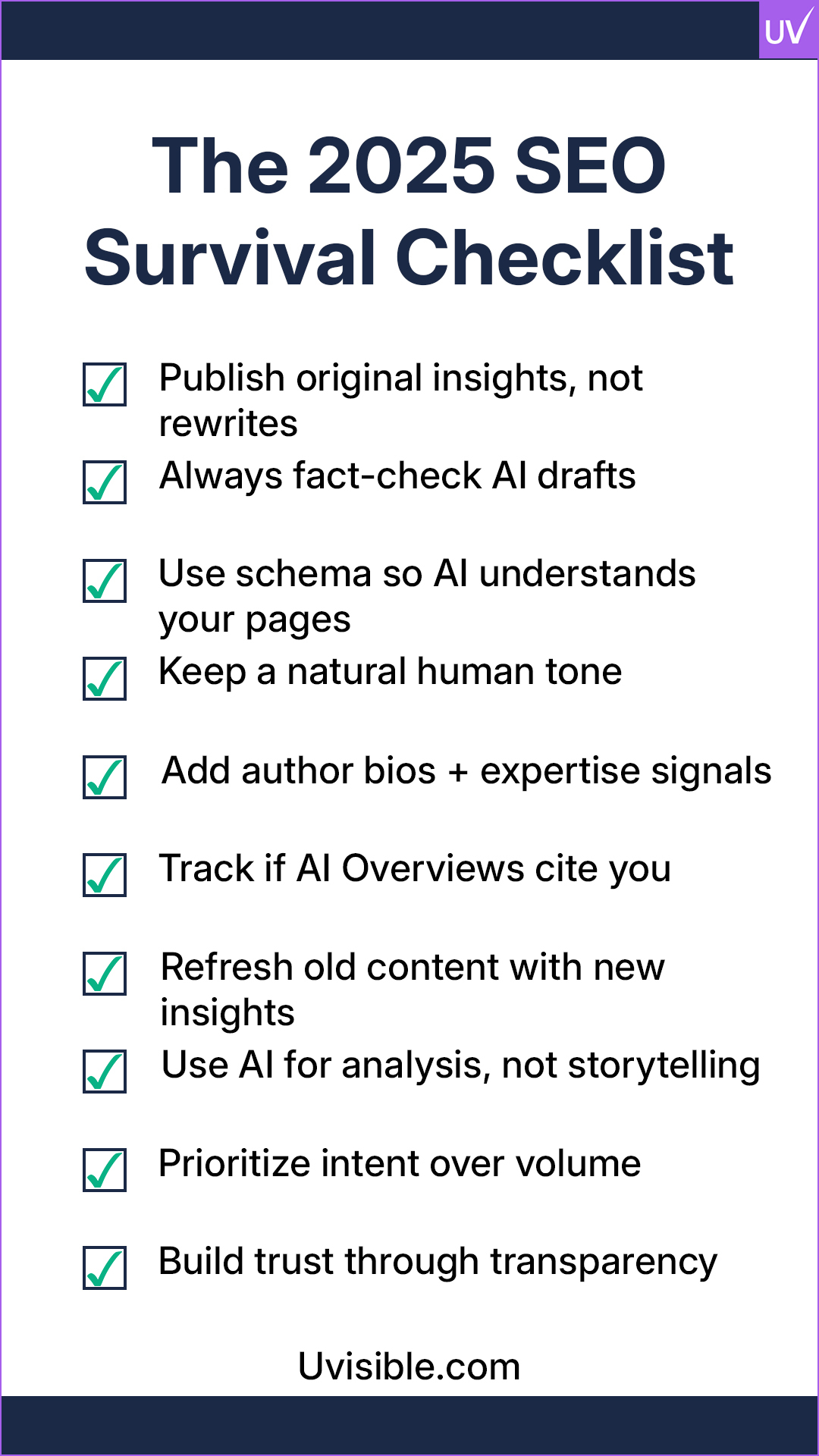
Want to stay on top of the AI tide? Here’s your go-to playbook:
- Instead of publishing rewrites, publish original insights.
- Verify AI-generated drafts for accuracy at all times.
- To aid AI in interpreting your pages, use schema markup.
- Make sure your tone is consistently human—neither too formal nor too impersonal.
- Include author biographies and evidence of your expertise.
- Check to see if Google's AI is citing you by tracking your content in AI Overviews.
- Add new human insights to outdated content.
- AI should be used for analysis, not narrative.
- Pay attention to search intent rather than search volume.
- Gaining long-term trust requires being morally upright and open.
Myth vs Reality: Busting AI-SEO Misconceptions
Hot takes on Google's ranking algorithms and AI content have been all over the internet; some are accurate, while the majority are completely ridiculous.
Before you make your next SEO strategy, let's dispel the myths surrounding clickbait.
| Myth | Reality Check |
| "AI content is banned by Google." | Not at all. Google despises poor content, not AI. Google doesn't care if it was created by a human, a bot, or a keyboard-wielding cat as long as it's accurate, helpful, and people-first. |
| "Blogs created by AI always rank lower." | Again, untrue! When edited and fact-checked by humans, AI content can rank extremely well. According to SEJ, 72% of marketers reported no decline in rankings following the integration of AI, or even an increase. |
| "You can use ChatGPT to automate your entire blog and stop there." | "You can use ChatGPT to automate your entire blog and stop there." A huge error. Human insight, unique stories, and empathy—the secret sauce that Google rewards with E-E-A-T—cannot be replaced by AI. AI should be used as a co-pilot rather than the captain. |
| “AI Overviews will kill organic SEO.” | Not even close. They will undoubtedly alter the game, but companies that prioritize structure, trust, and specialized knowledge will continue to be visible. It's evolution, not death. |
| “AI content is unethical.” | Only if it's used dishonestly. The moral path? Be open and honest. Integrate human creativity with AI efficiency. You scale and maintain credibility in this way. |
| “AI will make all SEOs obsolete.” | Oh, please. The value of SEOs who adapt to AI will increase. The indolent ones will disappear, but the data-driven, strategic storytellers? They represent the future. |
Pro Tip
You're already one step behind if you're wasting your time worrying about AI rather than learning it.
Employ AI to increase your reach, expedite your process, and identify opportunities more quickly, but always allow people to tell the story.
Conclusion
Let's face it, AI is coming for your lazy habits, not your job.
AI will take your place if your SEO strategy still consists of producing keyword-stuffed nonsense.
However, you will succeed if you can combine human depth with machine efficiency, as well as creativity and technology.
The SEOs that will succeed in 2025 and beyond are aware of AI, not hostile to it. They use it bravely, sensibly, and morally.
Additionally, Uvisible can help if you're unsure of where to begin.
In order to rank well, maintain ethics, and gain trust in the AI era, we assist brands in developing human-centered, AI-optimized SEO strategies.
We have all the strategies you need to stay ahead of Google, from content audits to E-E-A-T optimization to AI Overviews tracking.
As an outsource SEO agency, we help you future-proof your SEO strategy with precision and clarity.
Ready to future-proof your SEO strategy?
Together, we can make your brand Uvisible rather than just visible.
Contact Uvisible today, and we’ll help you turn AI confusion into SEO domination.
About us and this blog
We are a digital marketing company with a focus on helping our customers achieve great results across several key areas.
Request a free quote
We offer professional SEO services that help websites increase their organic search score drastically in order to compete for the highest rankings even when it comes to highly competitive keywords.
Subscribe to our newsletter!
More from our blog
See all posts





Recent Posts
- How SEO Works in Bing (And Why Ignoring It Might Be Costing You More Than You Think) February 27, 2026
- Things Every Website Should Have: The Complete SEO Blueprint February 14, 2026
- Digital Marketing Conferences 2026: Top Global Events for Marketing Leaders February 7, 2026
Pingback: AI-Written Content vs Google’s Search Standards: What SEOs Must Know
Pingback: Manipulating AI For Your Brand Benefit: Proven Techniques To Win